When Salary Packaging Actually Saves Tax (And When It Doesn’t) for Employees of Small Businesses
When salary packaging actually saves tax depends on the type of benefit, the employee’s taxable income and the total cost of the arrangement. A salary package can reduce income tax in some situations, but it does not always leave an employee with more money or a higher take-home pay. For Australian workers employed by small businesses, salary packaging can include superannuation contributions, a novated lease, work-related equipment and certain personal expenses. The result depends on whether the benefit attracts Fringe Benefits Tax (FBT), whether fees apply and whether the employee would have paid for the expense from after-tax income anyway.
Salary Packaging Changes How Part of Your Pay Is Received
Salary packaging, also called salary sacrifice, is an arrangement where an employee agrees to permanently give up part of their future gross salary in return for benefits of a similar value. The amount is generally taken from pre-tax salary, which can reduce taxable income and the income tax withheld from regular pay. An effective salary packaging arrangement must be entered into before the employee performs the work that earns the salary. The employer then provides the agreed benefit or pays an agreed expense, while the employee receives less pre-tax salary as cash in their bank account.
Salary packaging may cover:
- additional superannuation contributions;
- eligible work-related items;
- vehicle expenses through a novated lease; and
- certain expenses allowed under the employer’s arrangement.
These salary packaging options can produce tax savings, but the salary package depends on the employee’s income, personal circumstances and the tax treatment of the benefit.
Tax Savings Depend on the Employee’s Marginal Tax Rate
Salary packaging may help an employee pay less tax when the tax treatment of the benefit is more favourable than receiving the same amount as after-tax income. An employee on a higher marginal tax rate may receive a larger income tax benefit than someone who already pays little income tax. For example, an employee who directs part of their pre-tax income towards an eligible benefit may have less taxable income. However, the employee must compare any reduction in their tax bill with the cost of the benefit, administration fees and any amount included in the package to cover the employer’s FBT liability.
A lower amount of Pay as You Go Withholding (PAYGW) on a payslip does not always mean the employee is financially better off. The real result should be measured using total take-home pay, personal expenses, fees and any future commitments.
Superannuation Salary Sacrifice Can Be Tax Effective
Salary sacrifice into superannuation is one of the most common salary packaging benefits. The employee gives up part of their pre-tax salary, and the employer pays that amount into the employee’s super fund as an additional contribution. This may result in less income tax because salary sacrifice contributions are generally taxed at 15% in the super fund, although additional tax can apply in some circumstances. For 2026–27, the general concessional contributions cap is $32,500 and includes employer contributions, salary sacrifice contributions and personal contributions claimed as a tax deduction across all super funds.
An employee should also consider access to the money. Superannuation is generally preserved for retirement, so salary sacrifice can reduce disposable income available for mortgage repayments, rent payments, utility bills, childcare costs and other everyday expenses.
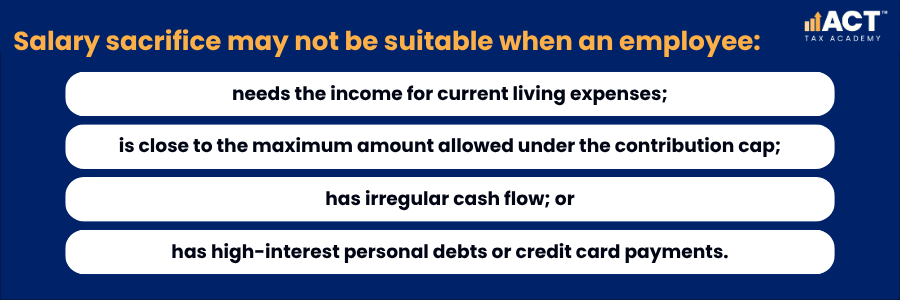
The tax benefit needs to support the employee’s broader financial position rather than simply reducing the tax shown on their payslip. Salary sacrifice contributions are additional to the employer’s compulsory super contributions and cannot be used to reduce the employee’s super guarantee entitlement.
Work-Related Benefits Can Provide Practical Savings
Certain eligible work-related items may be exempt benefits when they are primarily used in the employee’s employment. These can include portable electronic devices, computer software, protective clothing and tools of trade, subject to the ATO conditions. For an employee of a small business, receiving an eligible work-related item through a salary packaging arrangement may cost less than purchasing it with after-tax income. The employer should still keep clear records showing what was purchased, why it was required and how it relates to the employee’s duties.
For example, an employee who regularly works from home may need a laptop for business tasks. If the employer provides an eligible laptop that is primarily used for work, the benefit may be exempt from FBT, and the employee may avoid purchasing it from after-tax income. The benefit must still have a genuine work purpose. Packaging a personal device does not automatically make it exempt merely because it can also be used for work.

Fringe Benefits Tax Can Reduce or Remove the Saving
Fringe Benefits Tax (FBT) is a tax that an employer may need to pay when providing certain benefits to employees. Benefits such as private vehicle use, school fees, entertainment expenses and other personal expenses may attract FBT. Although the employer pays FBT, the cost may be included in the employee’s salary package. This can reduce the expected tax savings or make the arrangement more expensive than paying the expense from after-tax income.
Private sector employees generally have fewer opportunities to package everyday living expenses than employees of eligible not-for-profit organisations. Employees of eligible public benevolent institutions, health promotion charities, public or not-for-profit hospitals and public ambulance services may receive FBT-exempt benefits up to the relevant capping threshold, subject to the employer’s eligibility and salary packaging policy. Employees of ordinary small businesses should not assume they can package school fees, mortgage repayments, utility bills or credit card payments without FBT consequences. The employer or salary packaging provider should confirm which eligible expenses and specific benefits are available.
Novated Leases Require a Full Cost Comparison
A novated lease allows an employee to salary package a leased vehicle and certain vehicle expenses through their employer. Private use generally creates a car fringe benefit and may attract FBT, although an eligible electric car and its associated car expenses may qualify for the electric cars exemption. A novated lease can reduce taxable income, but it also creates a continuing financial commitment. From 1 April 2025, new arrangements involving plug-in hybrid electric vehicles generally do not qualify for the electric cars FBT exemption, although transitional treatment may apply to an existing financially binding commitment.
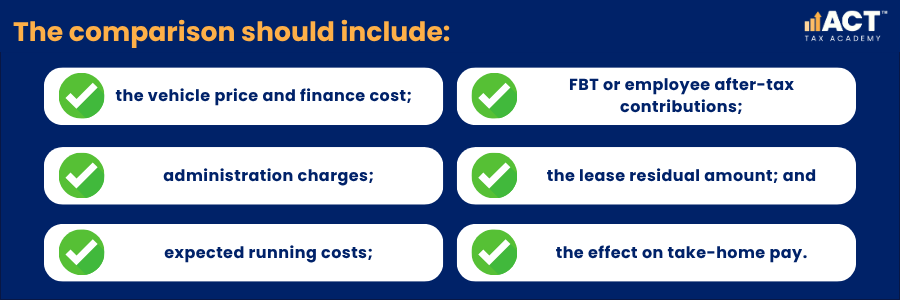
An apparent tax saving may disappear when the finance rate, fees or vehicle cost is higher than expected. An employee should also consider what happens if they change employers, take unpaid leave or end the arrangement early.
Salary Packaging Can Affect Other Financial Calculations
If the total taxable value of certain benefits provided to an employee or their associate exceeds $2,000 in an FBT year from 1 April to 31 March, the employer generally reports a grossed-up reportable fringe benefits amount. It is not included in taxable income or directly taxed, but it can affect income tests, government benefits, child support, the Medicare levy surcharge and other obligations. This means salary packaging can affect more than the amount of tax deducted from each pay. An employee may pay less income tax but experience a different result elsewhere, particularly where household benefits or income-tested obligations apply.
Employees should review the effect on their personal circumstances before leveraging salary packaging. The Australian Taxation Office (ATO) rules, employer policy and package terms should all be considered before the employee signs an agreement.
A Real Saving Requires More Than a Lower Tax Bill
Salary packaging works best when the employee needs the benefit, the benefit receives favourable tax treatment and the fees remain reasonable. It is less useful when the employee takes on unnecessary expenses simply to reduce taxable income. Before proceeding, the employee should compare their position with and without the package. The review should include gross salary, pre-tax deductions, after-tax income, FBT, package fees, superannuation contributions and the actual value of the benefit.
A useful salary packaging calculation should show:
- the employee’s original salary;
- the reduced taxable income;
- estimated income tax;
- fees and FBT;
- take-home pay; and
- the cost of obtaining the benefit privately.
A salary packaging provider may prepare this comparison, but the employee should still review the assumptions. A package based on unrealistic running costs, a long finance term or expenses the employee would not otherwise pay may not deliver a sustainable benefit.

Build Practical Bookkeeping Skills
Salary packaging can help employees pay less tax when the benefit is suitable, the tax treatment is favourable and the total cost is lower than paying from after-tax income. Small businesses also need correct payroll records, clear agreements and reliable calculations to manage salary packaging services properly. If you are ready to move from theory to practical application, the ACT Tax Academy Bookkeeping Online Course provides structured online training designed specifically for Australian small business owners and aspiring bookkeepers. You will learn how to set up and manage GST, prepare BAS, use Xero effectively, and implement compliant bookkeeping systems with confidence.