When to Consider a Holding Company: Tax, Risk and Growth Factors for Small Businesses
When to consider a holding company depends on whether your business needs a clearer structure for growth, ownership, asset separation or future investment. Business owners often reach this point when one company begins holding valuable assets, operating across multiple businesses or taking on more commercial risk. A holding company structure can support expansion, but it also adds accounting, tax and legal responsibilities. Before creating a new company, you should understand how the entities will operate, how money will move through the group and whether the expected benefits justify the added cost.
What Is a Holding Company?
A holding company is a company that owns shares in one or more subsidiaries. It usually does not produce goods or services or manage day-to-day operations in the same way as an operating company. In simple terms, the holding company sits above other companies in a group. It may own a controlling interest in a subsidiary, hold investments or manage the ownership of several subsidiary businesses.
How the Parent and Subsidiary Relationship Works
A holding company may also be called a parent company when it controls one or more subsidiaries. Control commonly comes from owning enough voting stock or voting rights to influence decisions about the subsidiary’s strategy, directors and management. Each subsidiary remains a separate legal entity. This means it generally has its own contracts, bank accounts, employees, income, taxes, operations and financial records.
Holding Company Versus Operating Company
An operating company carries out the active work of the business. It may employ staff, serve customers, sign contracts, produce goods or services and manage the daily use of cash and other resources. A holding company usually focuses on ownership, investments and oversight. For example, one company may operate a bookkeeping business while the holding company owns the shares in that business and another subsidiary operating in a different industry.
How a Holding Company Structure Supports Growth
A holding company structure can make it easier to manage multiple businesses under one ownership group. The parent company can own one subsidiary, several subsidiary companies or other subsidiaries established as the business expands. This approach can also help business owners separate the performance, ownership and financial management of different operations. However, each business entity still needs proper records, clear responsibilities and its own commercial purpose.

Expanding into New Markets or Industries
A new company may be created as a subsidiary when a business enters a new industry, launches a new service or acquires another business. This can help the owner track each operation separately rather than placing every activity inside one company. For example, a training business may establish one subsidiary for education services and another for software development. The holding company holds the ownership interest in both, while each subsidiary manages its own employees, customers and contracts.
Bringing in Investors
A group structure can provide more flexibility when investors want to invest in only one part of a business. Rather than giving an investor an interest in the entire portfolio, the business may issue shares in one subsidiary. This arrangement can help the existing shareholders retain control of other businesses or valuable assets. The rights of investors and other shareholders should be clearly documented, including voting rights, access to profits and the process for selling shares.
Preparing for a Future Sale
A holding company may help owners prepare for the future sale of one business without selling the whole group. If each operation is already held in a separate subsidiary, the owner may be able to sell the shares in that company while retaining other subsidiaries. The tax consequences of a sale depend on the assets, ownership history and way the transaction is completed. A qualified accountant and lawyer should review the proposed structure well before any sale or transfer.

Separating Assets from Day-to-Day Operations
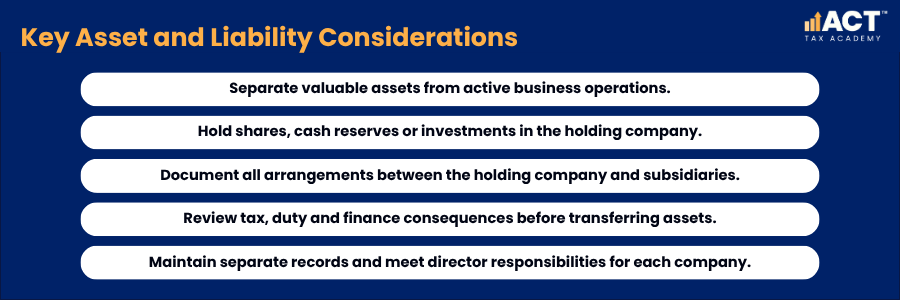
One reason business owners consider a holding company is to separate certain assets from active business operations. The holding company may hold assets such as shares, cash reserves or business investments, while the operating company carries out the riskier trading activities. This separation may support a broader asset protection strategy, but it does not provide complete protection from all claims or liabilities. Guarantees, unpaid debts, director conduct, incorrect transactions and poor record keeping can still create legal and financial problems.
Holding Valuable Assets
Some business owners prefer not to keep every valuable asset inside the company that signs customer contracts or manages employees. A holding company may own selected assets and allow a subsidiary to use them under a properly documented arrangement. The tax and legal treatment depend on the type of asset and the terms of the arrangement. Moving existing assets into another company may trigger CGT or other tax consequences, although eligible businesses may be able to use a restructure rollover when all relevant conditions are met.
Understanding Liability Between Companies
Each company is generally responsible for its own liabilities because it is a separate legal entity or body corporate. However, the practical separation can weaken if companies share money without records, enter joint contracts or rely on the same guarantees. Directors must continue to meet their legal responsibilities for every company in the group. A board of directors cannot assume the holding company structure automatically removes personal or group-level risk.
Tax Factors to Review Before Restructuring
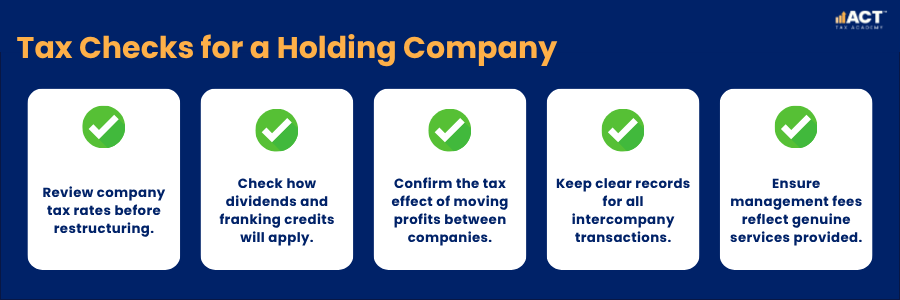
A holding company may produce different tax consequences in some circumstances, but the outcome depends on how each company earns income, receives dividends and distributes profits. Simply adding another company does not automatically reduce the total taxes paid by the owner or group. A qualified accountant should review company tax rates, dividend treatment, franking credits, Capital Gains Tax (CGT) and the movement of money between group entities. The proposed structure should support a genuine business purpose rather than rely on a general claim of tax savings.
Moving Profits Through the Group
An operating company may pay franked, partly franked or unfranked dividends to a parent company when the distribution meets the relevant legal and tax requirements. The holding company may retain the cash for future investments, support other subsidiaries or later distribute profits to its shareholders, subject to the applicable dividend and franking rules. The timing and tax effect of each payment must be reviewed. Profits belong to the company, and Division 7A may treat certain payments, loans or benefits provided to individual shareholders or their associates as unfranked dividends.
Managing Intercompany Transactions
Intercompany transactions are payments or transfers between companies in the same group. They may include loans, service charges, management fees, asset purchases, dividends or repayments. Each transaction should reflect its actual purpose and have supporting records. Separate bank accounts, written agreements, invoices and accurate loan balances help establish whether amounts are loans, dividends, service fees, asset payments or repayments and support the correct tax treatment.
Reviewing Management Fees
A holding company may charge management fees when it provides genuine services to a subsidiary. These services may include financial management, administration, strategy or access to shared resources. Management fees should relate to services that are reasonably connected with the subsidiary’s business, be correctly calculated and be supported by evidence of the work performed. Fees that are disproportionate or grossly excessive compared with the commercial benefit provided may not be fully deductible.
Build Practical Bookkeeping Skills
A holding company may be appropriate when a business is growing, managing several operations, bringing in investors or separating selected assets from active trading activities. The structure works best when each company has a clear purpose, separate records and properly documented transactions. If you are ready to move from theory to practical application, the ACT Tax Academy Bookkeeping Online Course provides structured online training designed specifically for Australian small business owners and aspiring bookkeepers. You will learn how to set up and manage GST, prepare BAS, use Xero effectively, and implement compliant bookkeeping systems with confidence.