
From Annual to Weekly: How to Estimate Your Business Tax Liability on a Weekly Basis
From Annual to Weekly: How to Estimate Your Business Tax Liability on a Weekly Basis is all about answering a simple question many owners ask: how much tax do I pay weekly. Turning your income tax into a weekly dollar amount gives you clarity, smoother cash flow, and fewer surprises. It also helps you see how the tax-free threshold, tax offsets, and the Medicare levy affect the amount of tax you need to set aside each week.
Many small businesses and workers in Australia only think about tax at the end of the financial year, when the figure can feel overwhelming. By building a weekly estimate into your budget, you treat tax like any other regular payment rather than a sudden debt. This approach is just as useful for wages and salaries as it is for business income, support loans, and other taxable income.
What Does Your Annual Business Tax Liability Actually Cover?
Your annual business tax liability is the income tax calculated on your taxable income for the financial year, after deductions and any tax offsets are applied. It usually includes income from your business, wages from employment, and other taxable income such as interest, investment returns, or certain support loans. From this total, the tax that has already been withheld during the year is taken off, including PAYG amounts from your employer or your own business.
On top of standard tax rates, Australian residents may also pay the Medicare levy and, in some cases, the Medicare levy surcharge, depending on income and private health arrangements. Your final figure can also be affected by whether you are entitled to exemptions or reductions through a Medicare levy variation declaration or other rules. Once this annual amount of tax is known or estimated, you can divide it into a weekly figure that is easier to plan around.
How Do You Turn Annual Tax Into A Weekly Estimate?
To estimate how much tax you pay weekly, start by working out your expected taxable income for the financial year, then apply the relevant tax rates and Medicare levy to find your total income tax. If you are an Australian resident who can claim the tax free threshold, make sure that is included in your calculation. After that annual amount of tax is calculated, divide it by 52 to get an approximate weekly amount.
You can use an income tax calculator or tax withheld calculator or refer to other tax tables on the ATO website, to check your figures. These tools ask for required information such as your income, pay frequency, whether you are claiming the tax-free threshold, and if you have any training support loans to repay. Once you see the yearly amount of tax and withholding amount, turning it into a weekly estimate is just a matter of simple division.
Key Elements of Your Annual Tax Picture
- Add-ons and adjustments: Medicare levy, possible surcharge, and any support loans to repay.
- Taxable income: business profit, wages, and other taxable income for tax purposes.
- Deductions: costs you can claim that reduce your taxable income.
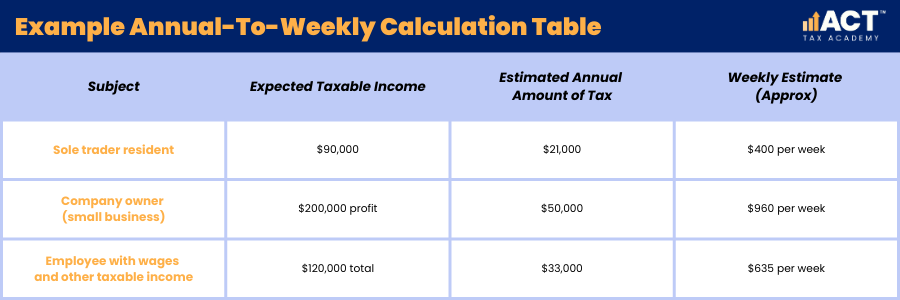
Figures are examples only and will vary based on tax offsets, Medicare levy, and your own situation.
How Does PAYG Instalment Planning Help Your Weekly Estimate?
If you run a business, PAYG instalments let you prepay your income tax through the year instead of facing one large amount at the end. The ATO often uses figures from a previous financial year to estimate your instalments, although you can vary them if your income changes. Each instalment can then be broken into a weekly amount to make the payments easier to manage.
For example, if a quarterly instalment comes to $13,000, you can set aside around $1,000 each week so that the money is already in your account when the due date arrives. This helps you keep tax in line with your income, even if payments from clients or customers are irregular. For workers who also have business income, aligning PAYG instalments with your weekly planning can reduce the likelihood of a surprise debt.
Turning Instalments into Weekly Amounts
- Review instalments when your income, pay, or deductions change.
- Convert quarterly PAYG instalments into weekly savings targets.
- Include any expected income tax on wages or salary that is not fully covered by tax withheld.

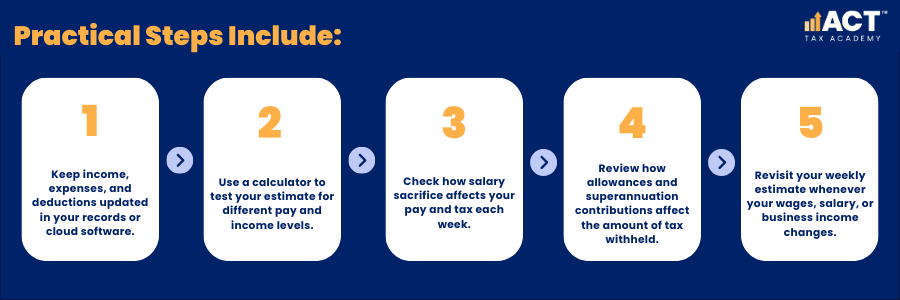
What Practical Steps Help You Estimate Weekly Tax Accurately?
Accurate weekly tax estimates start with solid records of your income, wages, and payments, along with a clear view of your deductions. If you are both an employer and an employee in your own business, check that the withholding amount for you and your workers matches the relevant tax tables. Regular bookkeeping and bank account reviews mean your estimate is based on current figures instead of guesswork.
You can also refer to the ATO website for other tax tables and calculators that show how much tax is usually withheld from different wage levels for Australian residents and working holiday makers. These tools use information such as whether you are claiming the tax free threshold, whether you have a withholding declaration or Medicare levy variation declaration, and if you have training support loans that need to be repaid. Matching your weekly pay to the right table line is a simple way to cross-check your calculation.
How Can Weekly Tax Estimation Improve Cash Flow and Reduce Stress?
When you turn your annual income tax into a weekly figure, tax becomes a normal part of your money plan instead of a once-a-year shock. Moving that weekly amount into a separate account helps make sure you have enough to cover income tax, the Medicare levy, and any repayment of support loans. This is especially helpful if you have children or dependants and want clear visibility over your household budget.
Weekly planning also helps if your payments are irregular, such as seasonal work in the horticultural industry, project-based roles, or casual workers with changing hours. In these cases, you can still apply a broad percentage to each week’s income to estimate how much tax to set aside. Over a full year, this approach reduces the risk that unpaid tax will build into a larger debt.
Benefits of weekly estimation include:
- More confidence when making decisions about wages, staff, and other commitments.
- Smoother cash flow, with fewer surprises at the end of the financial year.
- Better planning for superannuation contributions, savings, and future goals.
How Do Different Situations Affect Your Weekly Tax Estimate?
Your situation has a big impact on how much tax you pay weekly and how your estimate should be calculated. Australian residents can usually access the tax-free threshold, while working holiday makers have different tax rates and other tax tables. People with support loans or training support loans often need to repay those once their income passes certain figures, which should be factored into their weekly plan.
If you are on a working holiday or in temporary roles, you might receive payments from more than one employer across Australia during the financial year. In these cases, it is important to check that enough tax is being withheld overall, especially if you claim the tax-free threshold from more than one employer. A weekly estimate based on total income from all payees can help reduce the likelihood of a year-end debt.
Situations and Weekly Estimation Table
| Subject | Key Factors | Weekly Estimation Notes |
|---|---|---|
| Australian residents | Tax free threshold may apply; standard tax rates | Convert the yearly estimate to a weekly figure and review during the year. |
| Working holiday makers | Different tax tables; no standard threshold | Use working holiday calculators or tables to estimate weekly tax. |
| Workers with support loans | Repayments triggered once income reaches set figures | Build expected loan repayments into your weekly estimate. |
What Common Mistakes Do People Make with Weekly Tax Estimates?
A common mistake is focusing only on wages from one employer and ignoring other taxable income such as business income, interest, or side work. This can result in an estimate that is too low and a debt when the tax return is lodged. Another issue is relying on old tax rates or outdated tables instead of checking current information for the right financial year.
Some workers forget to update their withholding declaration when their circumstances change, such as taking a new job, changing hours, or no longer wanting to claim the tax free threshold from a second employer. Others do not review whether a Medicare levy variation declaration is still suitable for their level of income or family situation. Over time, small differences between what is withheld and what is actually owed can build up.
How Can Professional Advice Help You Turn Annual Tax into a Weekly Plan?
While tables and calculators are helpful, many people find that professional advice makes the process clearer and less stressful. An adviser can look at your income, deductions, wages, superannuation, and support loans to shape a realistic weekly estimate. This tailored approach makes sure you are not setting aside too little or tying up too much money unnecessarily.
If you are unsure about your numbers, it is wise to seek professional advice rather than rely on rough guesses. A supportive adviser can help set up simple systems so that the required information flows smoothly into your calculations each week or month. This means your weekly estimate keeps pace with changes in your pay, business income, or family circumstances.

Conclusion: Turning Knowledge into Action
From Annual to Weekly: How to Estimate Your Business Tax Liability on a Weekly Basis is about turning one big annual tax figure into a manageable weekly amount. When you know roughly how much tax you pay weekly, decisions about wages, drawings, savings, and spending become clearer and more confident. You also reduce the stress that comes from waiting to see the final amount of tax at the end of the financial year, because you have already planned for it.
The next step is to look at your income, deductions, and current withholding, then create a simple weekly estimate that suits your situation. Use a calculator or table as a starting point and update it as your circumstances change, checking the ATO website whenever you need further information or updated figures. If you need help tailoring the plan, seek professional advice so your weekly tax strategy supports both your business goals and your personal priorities.