Discretionary Trust vs Company in 2026: Tax, Compliance and Asset Protection Considerations
Discretionary Trust vs Company in 2026: Tax, Compliance and Asset Protection Considerations is a key decision for Australian business owners who want the right balance between tax planning, asset protection, control, and compliance. A discretionary trust and a company can both be useful, but each structure affects income tax, personal assets, family assets, trust income, and future business decisions differently. Many business owners ask what is a discretionary trust and whether it is better than a company for tax purposes. The answer depends on how income is earned, who should benefit from profits, whether assets need protection from creditors, and how the family plans to manage succession planning.
How a Discretionary Trust Works
A discretionary trust is a trust structure where a trustee has discretion to distribute income and capital to trust beneficiaries. The trustee exercises this power under the trust deed, which sets the rules for how trust property, trust assets, and the income of the trust can be managed. In many family discretionary trust arrangements, the beneficiaries include family members, such as a spouse, adult children, or related entities. For ATO purposes, a trust only becomes a family trust when the trustee makes a family trust election, so the trustee must check the deed, election status, and taxation rules before making distributions.
The Role of the Trust Deed
The trust deed is the main document that controls the discretionary trust structure. It explains who the trustee is, who the beneficiaries are, what power the trustee holds, and how income and capital may be distributed. A well-prepared deed can help the trustee manage distributions, allocate funds, and deal with assets held in the trust. From 1 July 2026, trustees also need to provide additional information in distribution statements to help beneficiaries report trust income correctly, so an outdated deed or poor record keeping can create problems when the family, business, or tax rules change.
Trustee Discretion and Income Distribution
A discretionary trust may give the trustee complete discretion to decide which beneficiaries receive income or capital. This does not mean the trustee can act without limits, because every decision must align with the deed and relevant law. For example, the trustee may distribute income to individual beneficiaries on lower marginal tax rates where the trust deed allows it, the beneficiaries are presently entitled by 30 June, and the arrangement is genuine and properly documented. This may create tax benefits, but trustees should also consider Tax File Number (TFN) withholding for closely held trusts, the higher tax rates that can apply to most distributions to minors, Personal Services Income (PSI) rules, and the need to seek professional advice.
How a Company Works
A company is a separate legal entity, which means it is legally separate from the person or people who own and control it. The company earns income, pays expenses, owns assets, and pays income tax in its own name. A company can suit family businesses that want to retain profits, bring in investors, or operate under a clearer ownership model. Shareholders own interests in the company, while directors manage the business and decide how profits are used.
Company Profits and Compliance
A company pays tax on its net income, and profits can remain in the company for working capital or growth. For the 2025–26 income year, the company tax rate is 25% for base rate entities and 30% for companies that do not qualify for the lower rate. A company must also meet Australian Securities and Investments Commission (ASIC) obligations and maintain proper financial records. Directors must manage the company carefully and make sure it can pay its debts.
Comparing Tax Treatment and Control
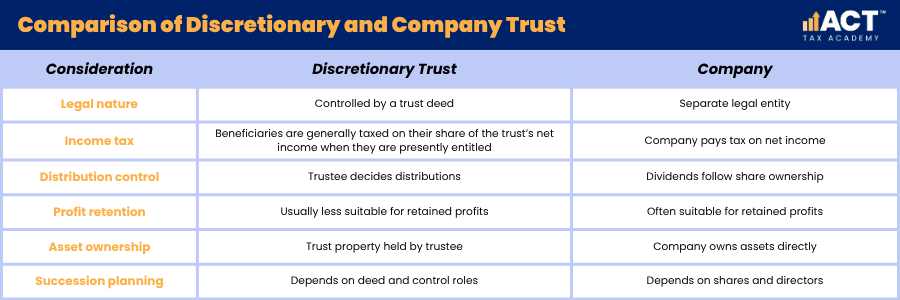
The main taxation difference is that a discretionary trust usually allocates trust income to beneficiaries through valid distributions, while a company is taxed on its own income. For tax purposes, a beneficiary who is presently entitled on 30 June is generally assessed on their share of the trust’s net income for that income year, while a company may be more useful for retaining profits. A discretionary trust may distribute income and capital to family members in different ways each year. A company provides less distribution flexibility, but it may offer a clearer tax position where profits are kept inside the business.
Asset Protection Considerations for Business Owners
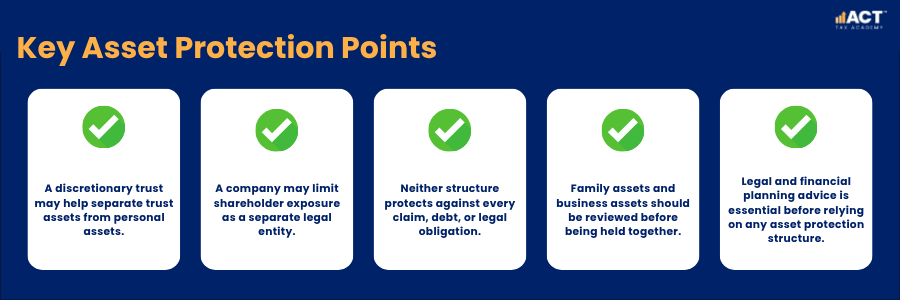
Asset protection is one of the key advantages often associated with a trust, but it needs to be understood carefully. A discretionary trust can help separate trust assets from personal assets, while a company can limit shareholder exposure because it is a separate legal entity. Neither structure gives complete protection from every claim. Creditors, personal guarantees, director duties, tax debts, and poor record keeping can all reduce the practical benefit of a structure, so readers should seek legal advice and financial planning advice before relying on any trust or company arrangement for asset protection.
Protecting Family Assets and Business Assets
A family discretionary trust may be used to hold family assets or investment property separately from a trading business. This can help reduce risk where business creditors make a claim against the trading entity, but the legal effectiveness depends on the full circumstances. For example, a business owner may operate through a company while property held for long-term family wealth is kept in a separate trust. This may support asset protection, but stamp duty, Capital Gains Tax (CGT), income tax consequences, legal obligations, and financial planning considerations must be reviewed before transferring assets.
Using a Corporate Trustee or Trustee Company
A corporate trustee is a company appointed to act as trustee of the trust. This can create cleaner administration and reduce the risk of an individual trustee being personally involved in every trust obligation. A trustee company may also help with continuity if a person dies, becomes unable to act, or the family needs to update control arrangements. However, the trustee must still manage trust property in line with the deed and any legal advice received.
When A Discretionary Trust May Be Suitable
A discretionary trust may suit family businesses that want flexible income distribution, family wealth planning, and separation between control and benefit. It may also suit situations where income and capital need to be shared among beneficiaries over time. This structure can be tax effective in the right circumstances, but it should not be treated as a simple tax saving tool. The trustee must decide distributions properly, keep records, and understand how trust income is taxed.
When A Company May Be Better
A company may be better where the business needs retained profits, clear ownership interests, or a structure that can support outside investors. It may also suit businesses that want to separate business operations from individual owners. Because a company is taxed as its own entity, it can be easier to plan around reinvestment and growth. Directors still need to manage wages, dividends, loans, and company money carefully, because private company payments, loans, debt forgiveness, and some trust entitlements can trigger Division 7A consequences if they benefit shareholders or their associates.
Other Issues to Review Before Choosing
Choosing between a discretionary trust and a company should include more than income tax. Business owners also need to consider stamp duty, capital gains, control, succession planning, asset protection, and compliance costs. A deceased estate can also create extra complexity if control of the structure is unclear. Business owners should review wills, trust deeds, shareholder arrangements, appointor powers, and family control documents together.

Build Practical Bookkeeping Skills
Choosing between a discretionary trust and a company in 2026 requires a clear understanding of income, assets, tax rules, compliance, and family goals. A strong structure should help you manage business risk, protect wealth, distribute income properly, and keep records that support every decision. If you are ready to move from theory to practical application, the ACT Tax Academy Bookkeeping Online Course provides structured online training designed specifically for Australian small business owners and aspiring bookkeepers. You will learn how to set up and manage GST, prepare BAS, use Xero effectively, and implement compliant bookkeeping systems with confidence.