
Avoiding Common Luxury Car Tax Mistakes: Tips for Small Business Owners
Avoiding common luxury car tax mistakes can save your small business thousands of dollars and protect you from costly Australian Taxation Office penalties. With luxury car tax rates at 33% on new vehicles exceeding the current thresholds of $80,567 for standard cars and $91,387 for fuel efficient vehicles, even simple errors can have significant financial consequences.
Why Luxury Car Tax Compliance Matters for Small Businesses
Small business owners often underestimate the complexity of luxury car tax obligations, leading to costly mistakes that could easily be prevented. The Australian Taxation Office actively monitors luxury vehicle transactions and has increased its focus on compliance, particularly targeting behaviours that attempt to avoid paying luxury car tax.
Most Common Luxury Car Tax Mistakes Small Business Owners Make
Understanding the specific errors that trip up small business owners is the first step toward avoiding them. Based on Australian Taxation Office guidance and compliance data, several mistakes appear repeatedly across different businesses and industries dealing with luxury cars.
Using Incorrect Thresholds and Formulas
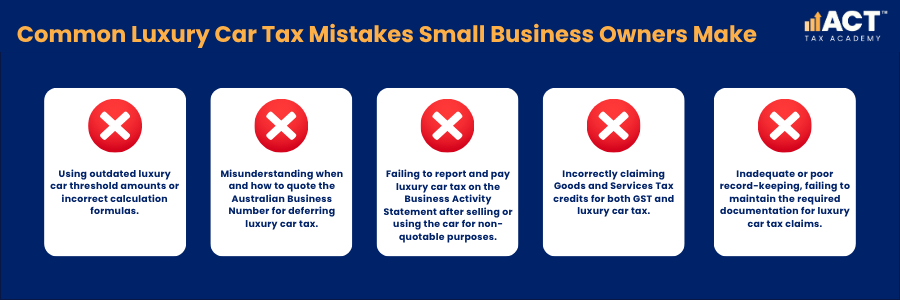
One of the most frequent errors involves using outdated luxury car threshold amounts or incorrect calculation formulas. The Australian Taxation Office updates these thresholds annually, and using last year’s figures can result in significant under or overpayment of tax.
For the 2025-26 financial year, the thresholds remain at $91,387 for fuel efficient vehicles and $80,567 for other vehicles. However, from 1 July 2025, the definition of fuel efficient vehicles changed significantly, reducing the maximum fuel consumption for qualification from 7 litres per 100 kilometres to 3.5 litres per 100 kilometres. This change means many vehicles previously considered fuel efficient no longer qualify for the higher threshold.
Electric vehicles and electric cars often qualify for the fuel-efficient threshold, but it’s crucial to verify their specific fuel consumption ratings. The federal government has been promoting electric cars as part of broader environmental initiatives, but this doesn’t automatically exempt them from luxury car tax if their retail price exceeds the relevant threshold.

Improper Australian Business Number Quoting
Many small business owners misunderstand when and how to quote their Australian Business Number to defer luxury car tax payments. The Australian Taxation Office allows Australian Business Number quoting only in specific circumstances: when you’re a luxury car dealer purchasing solely as trading stock, conducting research and development for the manufacturer, or intending to make a GST free export.
You cannot quote your Australian Business Number if you intend to use the luxury car for personal use, rally or race driving, staff salary packaging, promotion or sponsorship purposes, as an executive vehicle, or as a capital asset. Even if you plan to sell the car later, these restrictions still apply.
This confusion often arises because many business owners assume they can quote their Australian Business Number for any vehicle purchase, not realising the specific limitations that apply to luxury cars versus commercial vehicles or other cars used purely for business purposes.
Delayed Business Activity Statement Reporting After Sales
Dealers and resellers who initially deferred luxury car tax by quoting their Australian Business Number often make the critical error of not reporting and paying luxury car tax on their Business Activity Statement immediately after selling the car or starting to use it for non-quotable purposes. This timing mistake can result in significant penalties and interest charges.
The luxury car tax applies from the moment the vehicle is used for purposes other than those specified in the original Australian Business Number quote. This includes any personal use, demonstration drives beyond legitimate business purposes, or provision to staff members as benefits.
Incorrect Goods and Services Tax Credit Claims
Small business owners frequently claim Goods and Services Tax credits for both Goods and Services Tax and luxury car tax when they’re not entitled to claim back the full amounts. This error often occurs when businesses don’t fully understand the relationship between Goods and Services Tax and luxury car tax, particularly regarding the GST inclusive value calculations.
The GST component and luxury car tax serve different purposes within the tax system. While you might be entitled to claim Goods and Services Tax credits for legitimate business use, luxury car tax doesn’t provide similar credit mechanisms. Understanding these differences is crucial for accurate reporting on your Business Activity Statement.
Inadequate Record Keeping
Poor record keeping represents another major compliance risk area. The Australian Taxation Office requires comprehensive documentation to support luxury car tax claims, including proof of conducting an enterprise involving trade in luxury cars, acquisition and payment records including dealer delivery charges and financing costs, usage details while in possession, and information about sales or resupply.
Records must clearly distinguish between different vehicle types, whether they’re new vehicles or used cars, and their classification as luxury vehicles, commercial vehicles, or emergency vehicles. Station wagons, sports cars, and large SUVs each have specific considerations under the luxury car tax rules, and your records need to reflect these distinctions accurately.
Smart Strategies to Avoid Luxury Car Tax Pitfalls
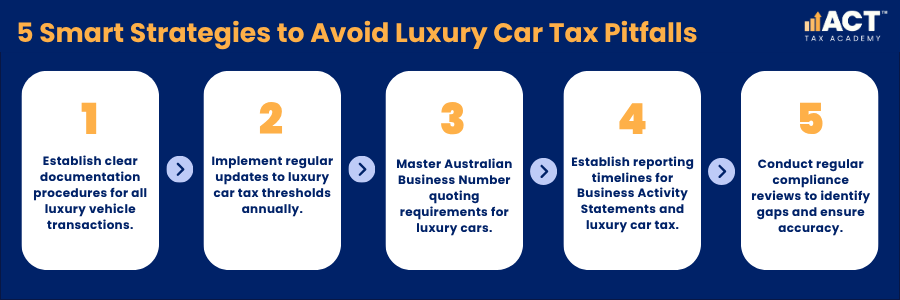
Implementing systematic approaches to luxury car tax compliance helps ensure your small business avoids common mistakes while maintaining good standing with the Australian Taxation Office. These strategies focus on establishing proper procedures, maintaining accurate records, and staying informed about regulatory changes affecting the luxury car tax system.
Establish Clear Documentation Procedures
Create a standardised system for documenting all luxury vehicle transactions from purchase through to sale or disposal. Your records should clearly show that you’re conducting a legitimate enterprise involving trade in luxury cars, including your motor dealer’s licence, evidence of suitable premises for storing and displaying vehicles, and approval to conduct motor trading at your business location.
For each vehicle transaction, maintain comprehensive records including orders and purchase documentation such as contracts and consignment agreements, bailment agreements showing when cars were placed into and removed from bailment with assigned values, importation details and dates for imported vehicles, and complete finance contracts showing legitimate business financing arrangements.
Documentation should clearly identify the total value of each vehicle, including the GST inclusive value and any additional costs such as dealer delivery charges, extended warranties, and compulsory third party insurance. For luxury cars, you need to calculate the luxury car tax value correctly, which may differ from the standard retail price depending on various factors.
Implement Regular Threshold Updates
Establish a systematic process for updating luxury car threshold amounts annually and whenever the Australian Taxation Office announces changes. Create calendar reminders for July each year to review and update your systems with the latest thresholds and any changes to fuel efficient vehicle definitions.
Consider the impact of threshold changes on different vehicle categories. Electric vehicles and fuel-efficient cars may qualify for different thresholds, while commercial vehicles, emergency vehicles, and vehicles with fewer than nine passengers may have specific exemptions or different treatment under the luxury car tax rules.
Motor homes, station wagons weighing less than two tonnes, and vehicles primarily used for carrying goods may have different luxury car tax implications compared to standard passenger cars or sports cars. Understanding these distinctions helps ensure accurate threshold application.
Master Australian Business Number Quoting Requirements
Develop clear internal guidelines about when your business can legitimately quote its Australian Business Number to defer luxury car tax. Ensure all staff involved in vehicle purchases understand the specific circumstances that allow Australian Business Number quoting and the restrictions that apply.
When quoting your Australian Business Number, use the exact format required by the Australian Taxation Office: “I hereby quote Australian business number [insert ABN] in relation to the supply of the luxury car as detailed above/attached.” Include your business name, the name of the person authorised to quote, their signature, and the date.
Remember that Australian Business Number quoting for luxury car tax differs from standard Goods and Services Tax Australian Business Number quoting. The restrictions are more stringent for luxury cars, and improper quoting can result in significant penalties beyond the original luxury car tax liability.
Establish Business Activity Statement Reporting Timelines
Create clear procedures for reporting luxury car tax on your Business Activity Statement using the same tax period as Goods and Services Tax reporting. If you’ve deferred luxury car tax by quoting your Australian Business Number, establish systems to ensure immediate reporting and payment once the vehicle is sold or used for non-quotable purposes.
Set up calendar reminders and internal checks to prevent delayed reporting, which represents one of the most common compliance errors. Consider using accounting software that can help automate these timeline reminders and ensure nothing falls through the cracks.
Your Business Activity Statement must accurately reflect the luxury car tax payable for each vehicle, calculated correctly based on the excess amount above the relevant threshold. For fuel efficient vehicles, ensure you’re using the correct fuel efficient threshold rather than the standard luxury car threshold.
Regular Compliance Reviews
Schedule quarterly reviews of your luxury car tax compliance procedures to identify any gaps or errors before they become significant problems. These reviews should include checking that all Australian Business Number quotes were legitimate and properly documented, verifying that Business Activity Statement reporting occurred on time for all transactions, confirming that record keeping meets Australian Taxation Office requirements, and ensuring staff training remains current with regulatory changes.
Consider how changes in the local car manufacturing industry, European Union import regulations, and federal government policies might affect your luxury car tax obligations. New vehicles entering the Australian market, particularly electric cars and other environmentally friendly options, may have different luxury car tax implications that require updated procedures.bligations. New vehicles entering the Australian market, particularly electric cars and other environmentally friendly options, may have different luxury car tax implications that require updated procedures.
When to Seek Professional Advice
Consider engaging a qualified tax advisor or registered tax agent when you’re purchasing your first luxury vehicle for business purposes, dealing with complex transactions involving multiple dealers, unsure about Australian Business Number quoting entitlements, or facing Australian Taxation Office inquiries or audits related to luxury car tax.
Professional advice becomes particularly valuable when dealing with imported vehicles, as the luxury car tax rules can be more complex and the consequences of errors more severe. Import luxury cars may have additional considerations including customs duty, stamp duty, and other Australian taxes that interact with the luxury car tax calculations.
Tourism operators, primary industries businesses, and endorsed public institutions may have specific exemptions or different treatment under the luxury car tax rules. Professional advice helps ensure you’re taking advantage of any legitimate concessions while maintaining compliance with the broader tax system.
Staying Informed About Changes
The luxury car tax landscape continues to evolve, with recent changes to fuel efficient vehicle definitions and potential future reforms being considered by the federal government. Staying informed about these changes helps ensure your business remains compliant as regulations evolve.
Subscribe to Australian Taxation Office updates, participate in relevant industry associations, and maintain regular contact with your tax advisor to stay current with luxury car tax developments. This ongoing education investment pays dividends in avoiding compliance problems and taking advantage of legitimate tax benefits within the Australian tax system.