
What Is Insolvent Trading and Why Should Australian Small Business Directors Care?
What is insolvent trading and why should Australian small business Directors care? Insolvent trading happens when a company is insolvent but keeps incurring company debts it cannot pay on time, and the law makes directors responsible for those decisions. Under the Corporations Act, this can lead to personal liability, civil and criminal penalties, and serious risk to your business and personal assets.
What Is Insolvent Trading Under Australian Law?
Insolvent trading occurs when a company is insolvent, or likely to become insolvent, and the company keeps incurring new debt it has no realistic way to pay. The Corporations Act sets out a duty to prevent insolvent trading, and this duty applies to all company directors, including directors of small proprietary companies. A holding company may also face separate liability under section 588V if its subsidiary trades while insolvent.
The law makes directors responsible for monitoring the company’s financial position and stopping new debts if there are reasonable grounds to suspect the company cannot pay debts as they fall due. If an insolvent company continues trading and later enters external administration, a director can face an insolvent trading action and be required to pay compensation out of their own assets if insolvent trading debts are proven.
Why Should Australian Small Business Directors Care?
Small business directors should care because insolvent trading laws can make a director personally liable for debt incurred when the company is insolvent. If a company fails and an external administrator or liquidator is formally appointed, they will review the company’s affairs to see whether directors allowed the company to incur debts when there were warning signs of financial distress.
If the company’s financial position was poor and the board continued selected creditors payments while leaving others unpaid, a director personally liable for those unpaid debts may be required to pay compensation. In some cases, criminal insolvent trading may be alleged, leading to criminal charges and criminal penalties where the director’s conduct was dishonest.
How Do You Know If Your Company Is Insolvent?
Directors must not wait until the company fails to assess the company’s finances. A company is insolvent when it cannot pay debts on time, even if directors are relying on new debt, credit cards, or support from associated parties’ creditors just to keep up with everyday bills.
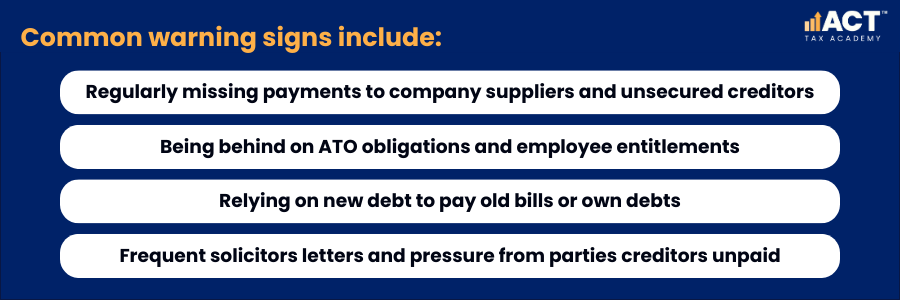
Warning signs that a company is insolvent include ongoing losses, overdue taxes, unpaid superannuation liabilities, company suppliers placing accounts on stop, and usual terms changing as creditors start effectively chasing money. Incomplete financial records, lack of a realistic business plan, and no clear view of the company’s financial situation are also strong signs that the company’s financial position is not under control.
What Are the Legal Consequences of Insolvent Trading?
If a company is insolvent and directors allow it to incur debts it cannot pay, they may face civil penalties, criminal penalties, and personal liability for those debts. In civil proceedings, a court can order directors to pay compensation equal to the loss suffered by creditors in relation to debts incurred while the company was trading while insolvent.
In certain circumstances, criminal insolvent trading charges may be brought where the director’s failure to prevent insolvent trading was dishonest. This can result in criminal charges, fines, and, in extreme cases, imprisonment, as well as being banned from managing corporations. Insolvent trading leaves directors exposed to both financial and reputational damage and can also trigger employee entitlement proceedings if staff entitlements remain unpaid.
What Is ASIC’s Guidance on Directors’ Duties?
Regulators expect directors to stay on top of the company’s finances and to act when there are reasonable grounds to suspect insolvency. The duty to prevent insolvent trading is not just about understanding the Corporations Act; directors must show they took real steps to monitor the company’s financial situation and respond to financial distress.
This includes relying on competent and reliable people for accurate financial information, keeping proper financial records, and reviewing up-to-date information about the company’s assets and liabilities. Where a company is incurring new debt, directors must consider whether the company can realistically pay debts on usual terms, rather than relying on collecting debts or unrecoverable loans that may never come in.

How Does Safe Harbour and Restructuring Help Directors?
Safe harbour and restructuring tools are designed to give directors space to work on a turnaround plan, instead of shutting down as soon as trouble appears. If directors promptly seek professional advice and develop a course of action that is reasonably likely to lead to a better outcome for the company than immediate administration or liquidation, they may be better protected from insolvent trading action for debt incurred as part of that plan.
Options can include informal restructuring, a company arrangement with creditors, or entering voluntary administration so an external administrator can assess the company’s affairs. In each case, the focus is on stabilising the company’s business, dealing fairly with parties’ creditors unpaid, and giving the company equivalent of a fresh start if it is viable.
What Practical Steps Should Directors Take When Warning Signs Appear?
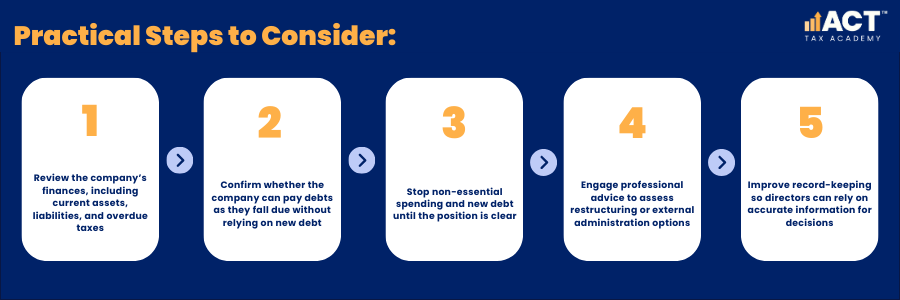
When warning signs of financial distress appear, directors should immediately seek professional advice from a professional accounting firm or restructuring specialist. The first step is to obtain an accurate picture of the company’s financial position, including up-to-date accounts, cash flow forecasts, and a realistic business plan showing how debts will be paid.
Directors should then work with advisers to decide whether the company can continue trading on usual terms, or whether it should stop taking new debt and consider external administration. In some cases, that may involve talking to a secured creditor about a security agreement, negotiating with unsecured creditors, or discussing options for voluntary administration or a company arrangement to deal with unpaid debts.
How Are Creditors, Employees, and Shareholders Affected?
When a company is insolvent, the impact extends beyond directors to employees, creditors, and shareholders. Company suppliers, employees, and unsecured creditors may face unpaid debts, while shareholders may see the value of their investment wiped out if the company fails.
If the company’s assets are not enough to pay all debts, a secured creditor with a valid security agreement may be paid first, leaving associated parties’ creditors and unsecured creditors with less or nothing. Employee entitlement proceedings may also arise to deal with wages and superannuation liabilities, and shareholders may have to accept that there is no return once all the person’s debts are addressed.
What Role Do Holding Companies and Parent Companies Play?
In some groups, a holding or parent company may influence or control the company’s business and decisions about how debts are managed. In certain circumstances, a parent company or holding company may also face scrutiny where it has been closely involved in directing the company’s affairs while the company is insolvent.
If a parent company has effectively been making key decisions, such as directing selected creditors payments or supporting ongoing trading while insolvent, its role may be considered in any insolvent trading claim. This is another reason why clear documentation, a sound business plan, and early professional advice are so important for groups, not just single entities.
How Can ACT Tax Academy Help You Manage Insolvent Trading Risk?
You do not have to face financial distress or insolvent trading risk on your own. Our professional accounting team can help you understand your company’s financial situation, strengthen your records, and spot warning signs early so you can take sensible steps before problems escalate.
We work with company directors to review the company’s finances, develop practical cash flow strategies, and decide whether it is safe to incur debts or whether it is time to consider voluntary administration or other external administration options. By seeking professional advice early, you can reduce the risk of being personally liable for insolvent trading debts and make better decisions for your company’s future.

Conclusion: What Should You Do Next If You Suspect Insolvent Trading?
If you are worried that your company is insolvent or close to it, the most important step is to seek professional advice and stop taking on new debt until you understand the situation. Take a careful look at your company’s financial position, including overdue taxes, superannuation liabilities, and pressure from creditors, and be honest about whether the company can pay debts as they fall due.
If there are reasonable grounds to suspect insolvency, act quickly to prevent insolvent trading by reviewing your options, from improving cash flow to considering voluntary administration or another form of external administration. Reaching out to an experienced advisor now can help you manage risk, protect your personal position, and give your company the best possible chance of a stable and sustainable future.