Running Multiple Businesses Under One Family Trust: Best‑Practice Bookkeeping and Tracking for Each Venture
Running Multiple Businesses Under One Family Trust can work well when each venture is tracked clearly, reported accurately, and reviewed regularly. The challenge is that one family trust can quickly become difficult to manage when income, expenses, loans, trust assets, wages, and tax records are mixed across different business interests. For many Australian families, a family trust may support asset protection, succession planning, and family control over business and investment assets. However, a properly structured family trust still needs disciplined bookkeeping so the trustee, tax agent, and beneficiaries can understand what each venture earns, spends, owns, and contributes to the trust’s total income.
What Is a Family Trust in a Business Context?
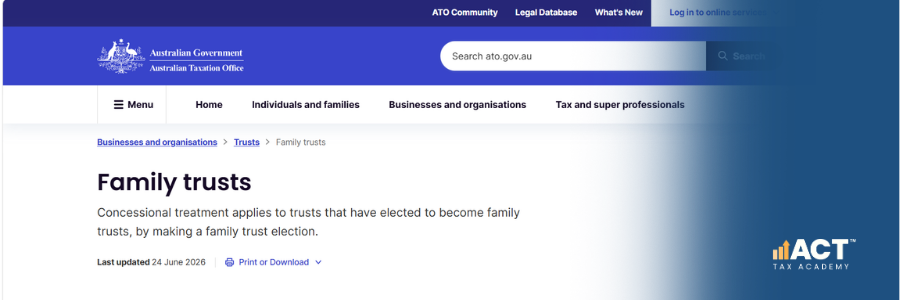
For ATO purposes, a trust becomes a family trust when the trustee makes a family trust election. In everyday business use, many Australian family trusts are discretionary trusts used to hold assets, operate a family business, or distribute income to beneficiaries of the trust, with the trustee or trustees managing trust assets under the trust deed for the trust’s beneficiaries. The trust deed is the legal document that sets out how the trust works, who may benefit, what powers the trustee has, and when the vesting date occurs. Before running multiple businesses through the same trust structure, the deed should be reviewed to confirm the trustee can carry on those activities.
Discretionary Trust Compared with a Unit Trust
A discretionary trust gives the trustee discretionary rights over how trust income and income and capital may be distributed to eligible beneficiaries. Beneficiaries generally do not have fixed ownership interests in the trust assets. A unit trust works differently because unit holders usually hold fixed units that determine their share of income and capital. Discretionary family trusts are common for a family business because they can provide flexibility, but they require careful tax planning and record-keeping.
The Trustee Is the Person Responsible
The trustee is the person responsible for managing the trust, keeping records, applying for the trust’s own Tax File Number (TFN), lodging the annual trust tax return, and recording how trust income was distributed. A trustee may be an individual, several individuals, or a corporate trustee. A corporate trustee can provide clearer separation between personal and trust affairs, but it may also involve Australian Securities and Investments Commission (ASIC) fees and ongoing costs. The trustee must still keep accurate bookkeeping records whether the trust has one venture or several.
How One Family Trust Can Run Several Ventures
One family trust may operate several business activities if the trust deed allows it, the trust is carrying on an enterprise, and the trustee manages each venture properly. For tax purposes, the trust should use its own Australian Business Number (ABN) for its business activities and register for GST if annual GST turnover is $75,000 or more. The key issue is not whether the trust can earn income from different sources, but whether the bookkeeping can separate each venture clearly. If all income and expenses are combined, the trustee may not know which business is profitable, which one is using cash, or which one is creating tax risk.
Tracking Each Venture Inside One Trust Structure
Each venture should have its own internal reporting view, even if the trust lodges one set of annual tax returns. Accounting software can usually separate activities through tracking categories, classes, departments, projects, or cost centres. For example, you might track “Retail”, “Consulting”, and “Property Services” as separate ventures. Each sale, supplier bill, payroll cost, software subscription, loan repayment, and asset purchase should be allocated to the correct activity where possible.
Keeping Family Business Reports Useful
A family business often relies on practical reports to decide whether to grow, restructure, or stop a venture. If the bookkeeping only shows the trust’s combined total income, the trustee may miss problems in one activity. Separate reporting shows which business is covering its costs, which one is relying on other ventures, and which one may need better pricing, staffing, or stock control. This gives the family group clearer information before making decisions.
Set Up the Bookkeeping System Before Transactions Build Up
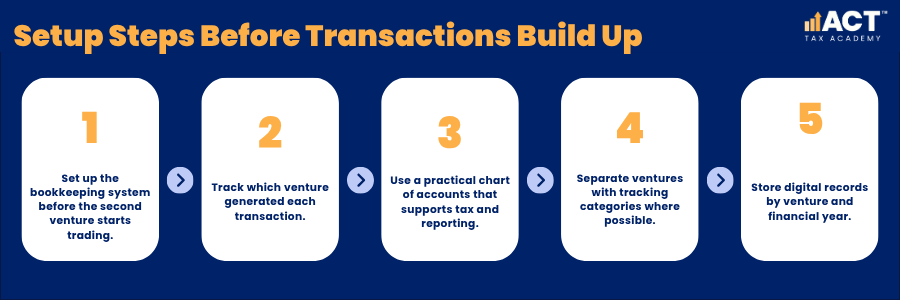
The best time to structure the bookkeeping system is before the second venture starts trading. Once hundreds of transactions have been coded incorrectly, it takes more time and cost to separate them properly. A good setup should answer three questions: which venture generated the transaction, which tax treatment applies, and whether the transaction belongs to the trust, a beneficiary, another company, or another related entity. This foundation reduces confusion at Business Activity Statement (BAS) time, year-end, and when preparing trust distribution information.
Use a Practical Chart of Accounts
The chart of accounts is the list of income, expense, asset, liability, and equity accounts used in the bookkeeping file. It should support income tax, Goods and Services Tax (GST), payroll, and management reporting without becoming too complicated. For most trusts, it is better to use a clear core chart of accounts and separate ventures through tracking categories. This keeps reports organised without creating unnecessary complexity.
Separate Bank Feeds and Digital Records
Separate bank accounts can make bookkeeping cleaner when each venture has different customers, suppliers, payment platforms, or cash flow needs. They also help the trustee see whether one business is funding another. Invoices, receipts, payroll records, loan documents, merchant reports, and allocation workings should be stored by venture and financial year and generally kept for five years. This makes it easier for the tax agent to review the records, support BAS amounts, and prepare annual tax returns.
Track Income, Expenses, and Shared Costs Properly
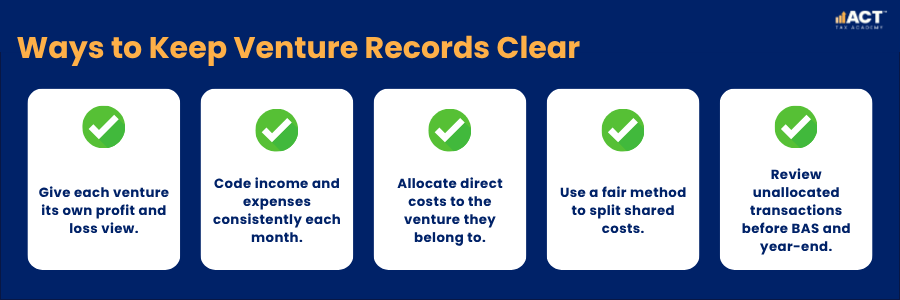
Each venture should have its own profit and loss view, even when the income later forms part of the trust income calculation. This allows the trustee to assess commercial performance before making tax planning and distribution decisions. The key is consistency. If wages, software, insurance, merchant fees, home office costs, and advertising are coded differently each month, the reports will not give a reliable picture.
Allocate Direct and Shared Costs Correctly
Direct costs are expenses that clearly belong to one venture, such as stock for an online store, subcontractors for a consulting project, or platform fees for a service business. These costs should be allocated directly to the relevant venture rather than spread across the whole trust. Shared costs support more than one venture, such as accounting fees, internet, rent, utilities, insurance, or administration wages. Common allocation methods include revenue percentage, time spent, floor space used, transaction volume, or staff headcount.
Review Unallocated Transactions Monthly
Unallocated transactions are a warning sign that the bookkeeping system is not being maintained properly. A monthly review should identify items coded to suspense, uncategorised income, uncategorised expenses, or “ask my accountant”. Leaving these items unresolved until year-end can create errors in GST, income tax, and venture-level reporting. A clean monthly file gives the trustee better information and reduces pressure before lodgment deadlines.
Manage GST, BAS, and Income Tax Across the Trust
If the trust is registered for GST, GST reporting usually applies at the trust level rather than separately for each internal venture. The BAS must include complete and accurate GST amounts and any other reportable obligations, such as Pay as You Go (PAYG) withholding if the trust has employees. The risk with multiple businesses is that one venture may have different tax treatment from another. For example, one activity may sell GST-free products, while another sells taxable services, so the bookkeeping must apply the right GST codes for each transaction.
Understand How Beneficiaries Pay Tax
In a discretionary trust, the trustee may make beneficiaries presently entitled to trust income in line with the trust deed and the trust’s tax planning position. Beneficiaries generally declare their share of the trust’s net income in their own income tax returns, rather than simply paying tax on cash distributions received. This does not mean income can be distributed without care. The trustee and tax agent must consider the trust deed, family group, family trust election, income tax rules, Medicare levy, marginal tax rates, and whether any beneficiary is a minor or non-resident before deciding who should receive trust distributions.
Watch Undistributed Income and Taxable Income
Undistributed income can create unexpected tax outcomes. In some cases, where no beneficiary is presently entitled to trust income, the trustee may be assessed on that income under the trust tax rules, which can result in a higher tax outcome. This is why year-end planning matters. The trustee should review trust income, taxable income, cash flow, beneficiary circumstances, and distribution minutes before the end of the financial year.
Protect Assets Without Losing Clear Records
A family trust is often used to hold family assets, protect assets, and separate business interests from personal ownership where appropriate, but it does not guarantee asset protection in every situation. Any asset protection benefit depends on the trust structure being properly set up, properly managed, and supported by clear records. Bookkeeping plays an important role because it shows which assets belong to the trust, which assets are private, and which assets are used by each business. Poor records can make it harder to explain ownership, business use, land tax exposure, and financial resource issues later.
Record Trust Assets Separately from Private Assets
Trust assets should be recorded clearly in the bookkeeping system and supporting records. This may include business equipment, vehicles, intellectual property, certain investments, trading stock, and bank accounts. Family assets held outside the trust should not be mixed with trust assets. If the trust pays for private costs or uses private assets, those transactions need to be recorded correctly. Clear records also support succession planning by showing what each venture owns, earns, and owes.

Build Practical Bookkeeping Skills
Running several businesses through one family trust can be efficient, but only when the bookkeeping clearly separates each venture while still supporting trust-level reporting. With the right chart of accounts, tracking categories, GST codes, payroll allocation, bank reconciliation, trust distribution records, and year-end review process, the trustee can make better decisions and reduce avoidable compliance stress. If you are ready to move from theory to practical application, the ACT Tax Academy Bookkeeping Online Course provides structured online training designed specifically for Australian small business owners and aspiring bookkeepers. You will learn how to set up and manage GST, prepare BAS, use Xero effectively, and implement compliant bookkeeping systems with confidence.