Paying Yourself from a Pty Ltd: Comparing Salary, Director Fees and Dividends
Paying Yourself from a Pty Ltd: Comparing Salary, Director Fees and Dividends starts with one key point: company money is not automatically your personal money. Many Australian business owners set up a Pty Ltd company for limited liability protection but still feel unsure about the right way to take money out for personal use. A Pty Ltd is a private company structure, and “Pty Ltd” stands for proprietary limited. This means the company is a separate legal entity with its own legal status, tax obligations, bank accounts, assets, and financial responsibility.
What Does Pty Ltd Mean for Business Owners?
A Pty Ltd company is a proprietary limited company that is privately owned and registered with the Australian Securities and Investments Commission (ASIC). It must have at least one director, a registered office address, and a registered company name. If the company carries on business or needs tax registrations, it should also apply for an Australian Business Number (ABN) and any required tax registrations, such as Goods and Services Tax (GST) or Pay as You Go (PAYG) withholding.
Unlike a sole trader, a Pty Ltd structure separates your personal assets from the company’s debts in many situations. This separation is one of the main reasons Australian business owners choose this business structure over other business structures.
Separate Legal Entity Explained
A separate legal entity can enter contracts, own assets, open bank accounts, employ staff, and take on business debts in its own name. This means the company, not the individual owner, usually carries the legal responsibility for company obligations. However, limited liability does not mean directors can ignore compliance obligations. Directors may still become personally liable in certain situations, especially where they breach legal obligations, misuse company money, fail to meet tax obligations, or allow the company to trade while insolvent.
How the Pty Ltd Structure Affects Paying Yourself
The Pty Ltd structure affects how you pay yourself because the company’s money belongs to the company first. You need to record payments properly as salary, director fees, dividends, loan repayments, reimbursements, or shareholder loans. This is where many business owners make mistakes. They may transfer money from the company account to a personal account without deciding whether the payment relates to work, ownership, expenses, or a temporary loan.
Why the Payment Type Matters
The payment type affects the company’s tax deductions, your personal income tax, superannuation, Pay As You Go (PAYG) withholding, and reporting obligations. A payment for work is treated differently from a dividend paid to shareholders. For example, if you manage customers, supervise staff, issue invoices, and handle daily operations, a salary may be appropriate. If you are paid for director-level duties such as strategy, governance, and shareholder meetings, director fees may be more suitable.
Paying Yourself a Salary from a Pty Ltd Company
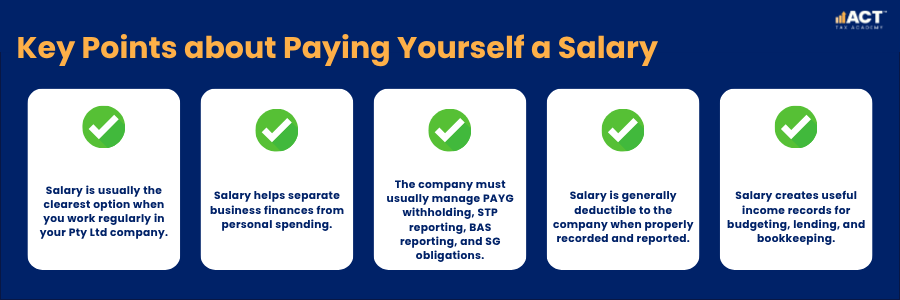
A salary is usually the clearest option when you work regularly in the business. It pays you for your labour and creates a structured payroll record that helps separate business finances from personal spending. For the company, salary is generally treated as a business expense when it is properly recorded and reported. For you, it becomes personal income and must be included in your individual tax return.
Payroll, PAYG and Superannuation
When a Pty Ltd pays salary, it usually needs to register for PAYG withholding, withhold PAYG amounts, report salary and withholding through Single Touch Payroll (STP), report withheld amounts on its Business Activity Statement (BAS) where required, and pay Superannuation Guarantee (SG) for eligible employees. This is part of the company’s compliance obligations as an employer.
Salary can also help with practical needs such as loan applications, regular household budgeting, and proof of income. It gives both the business owner and accountant a clearer picture of the real cost of running the business. For employee earnings paid from 1 July 2026, employers need to pay SG contributions for each payday instead of relying on the previous quarterly payment cycle.
Using Director Fees for Governance Duties
Director fees are payments made to a director for carrying out director responsibilities. These duties may include attending meetings, reviewing financial reports, making strategic decisions, managing risk, and meeting corporate governance requirements. For ATO purposes, director fees are generally assessable income to the director and usually require PAYG withholding by the company. Director fees are common where a person’s role as director is separate from their operational role in the business. This can be helpful in a private company with more than one director or shareholder.
Salary and Director Fees Are Not Identical
A working director may perform two different roles. One role is operational, such as managing clients, bookkeeping, sales, or staff; the other is governance, such as making decisions under the Corporations Act 2001. The salary pays for the operational work, while director fees pay for director responsibilities. Keeping these roles separate can make the company’s records clearer and support better financial reporting.
Taking Dividends From Company Profits
Dividends are payments made to shareholders from company profits. They are not paid because you performed work; they are paid because you own shares in the company. Dividends may be suitable once the company has paid its expenses, considered its tax obligations, and reviewed available profits. They should not be treated as a quick replacement for wages when the payment is really for work performed.

How Dividends Differ from Salary
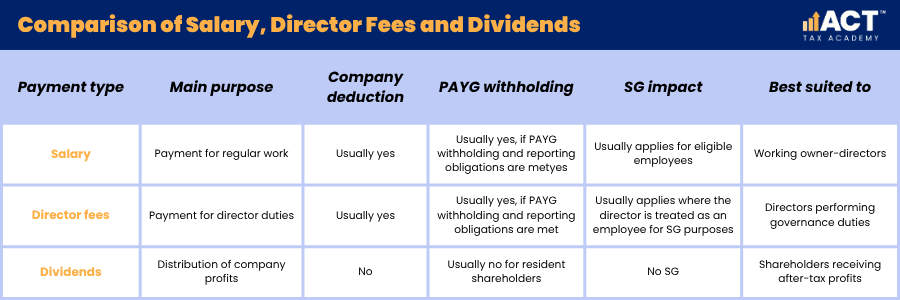
Salary and director fees are usually payments for services. Dividends are distributions to shareholders based on ownership, share capital, and the rights attached to the shares. A dividend is not usually deductible to the company. It is paid from profits, and the shareholder includes the dividend in their personal tax return.
Franked Dividends in Simple Terms
A dividend may be fully franked, partly franked or unfranked. A franked dividend includes a franking credit for company tax already paid, and the dividend statement should show the franked amount, any unfranked amount, and the franking credit. Franked dividends can be useful, but they depend on the company having enough franking credits and profits. The company should also keep proper dividend statements, resolutions, and franking account records.
Salary, Director Fees and Dividends Compared
The right choice depends on why the money is being paid. Salary pays you for work, director fees pay you for director duties, and dividends distribute profits to shareholders. Many business owners use a combination rather than choosing only one method. The best mix should reflect the company’s cash flow, personal tax position, SG obligations, business continuity needs, and whether the company is taxed at the 25% base rate entity rate or the 30% full company tax rate.
Limited Liability and Personal Risk
A Pty Ltd offers limited liability, which means shareholders are generally protected from the company’s debts beyond the amount unpaid on their shares. This is one of the main companies benefit points for business owners who want to protect personal wealth. However, liability protection is not absolute. Directors may still be personally responsible where they breach duties, provide personal guarantees, fail to meet certain tax obligations, or mix personal and company money carelessly.
Common Compliance Risks When Taking Money from a Pty Ltd
The main risk is using company money for personal purposes without recording the payment correctly. A payment to a director, shareholder, or related person may need to be recorded as salary, director fees, a dividend, reimbursement, loan repayment, or a properly documented loan. Division 7A may apply when a private company gives money or other benefits to shareholders or their associates. If the rules apply and the payment is not handled correctly, the amount may be treated as an unfranked dividend and included in the recipient’s assessable income.
Personal Services Income Can Affect the Outcome
Personal Services Income (PSI) is income produced mainly from your personal skills or efforts as an individual. PSI rules can apply even when the income is earned through a company, so a Pty Ltd structure does not automatically allow income to be retained or split for tax purposes. If PSI may apply, review the rules before deciding how much to pay as salary, director fees, or dividends. This helps prevent a payment strategy from being based on an incorrect tax assumption.

Build Practical Bookkeeping Skills
Paying yourself from a Pty Ltd is not just a tax decision; it is also a bookkeeping, payroll, and compliance decision. When you understand the difference between salary, director fees, and dividends, you can keep business finances clearer and reduce the risk of personal and company money becoming mixed.
If you are ready to move from theory to practical application, the ACT Tax Academy Bookkeeping Online Course provides structured online training designed specifically for Australian small business owners and aspiring bookkeepers. You will learn how to set up and manage GST, prepare BAS, use Xero effectively, and implement compliant bookkeeping systems with confidence.