Bookkeeping Systems for Tutoring and Side‑Hustle Teachers: Separating School Employment and Private Teaching Income
Bookkeeping Systems for Tutoring and Side-Hustle Teachers: Separating School Employment and Private Teaching Income helps teachers keep school salary, private tutoring income, and work related expenses clearly separated. This matters because many teachers ask what can teachers claim on tax, but the answer depends on whether the cost relates to employment, a second job, or private teaching activity.
Why Teachers Need Separate Records for Tutoring Income
Teachers need separate records because school employment income and private teaching income are not managed in the same way. Your salary from the same employer is usually reported through payroll, while private tutoring income generally needs to be tracked and declared as part of your taxable income. This separation also helps when claiming deductions. A cost connected with your current job as a school teacher may be treated differently from a cost connected with private lessons, so your records should show the purpose, date, amount, and work-related portion of each expense.
Employment Income and Private Teaching Income Have Different Records
Your school salary is usually linked to your Tax File Number (TFN), income statement, and employer payroll records. Private tutoring income may come from parents, students, tutoring platforms, bank transfers, or cash payments, and it should be recorded regardless of how it is received. For example, a physical education teacher may earn school wages during normal business hours and run private fitness coaching or exam preparation after school. The income from those private lessons should not be hidden inside personal banking or mixed with ordinary household spending.
Clear Records Reduce Tax Return Stress
A separate bookkeeping system gives your tax agent a clearer picture of your teaching duties, tutoring income, and expenses. It also helps you explain which costs relate to school employment, and which costs relate to private teaching. This can support a more accurate tax return and reduce the chance of missing income or overstating teacher tax deductions, helping you avoid common tax return mistakes. It may also help you plan for tax payable rather than assuming a larger tax refund will cover everything.
Building a Simple Bookkeeping System Before You Start
A good bookkeeping system starts with a separate bank account or sub-account for tutoring income and tutoring expenses. This makes it easier to see lesson payments, course fees, teaching aids, internet costs, mobile phones, and office equipment used for private teaching. You do not need a complex system on day one. A clear spreadsheet or accounting software file can work well if it records income, expenses, assets, student balances, and notes about the work-related percentage.
Use Separate Accounts and Payment Methods
Ask private students or parents to pay into your tutoring account rather than your everyday personal account. If you accept cash, record it the same day so it does not get missed. Use consistent payment descriptions such as “Year 12 English tutoring” or “Term 3 maths package”. These details make it easier to match payments to lessons and identify unpaid sessions.
Keep Receipts and Statements in One Place
Save credit card statements, bank records, invoices, and digital receipts in a folder for each financial year. Name each file with the date, supplier, and expense category. For example, a receipt for home office equipment could be saved as “2026-08-14-monitor-home-office-equipment”. This habit keeps your records useful if you need to review a deduction later.
Recording Teacher Tax Deductions, the Right Way
Tax deductions need to be supported by records that show what you bought, why you bought it, and how much relates to income-producing work. This is where a bookkeeping system helps because it separates employment deductions from tutoring business deductions. The phrase teacher tax deductions can cover many common expenses, but teachers claim only the part that relates to earning income. If something is personal, private, or only loosely connected to your work, you generally cannot claim it.
Common Expenses That May Need Tracking
Teachers and private tutors may need to track several types of expenses. The key is to record the connection between the cost and the work performed.
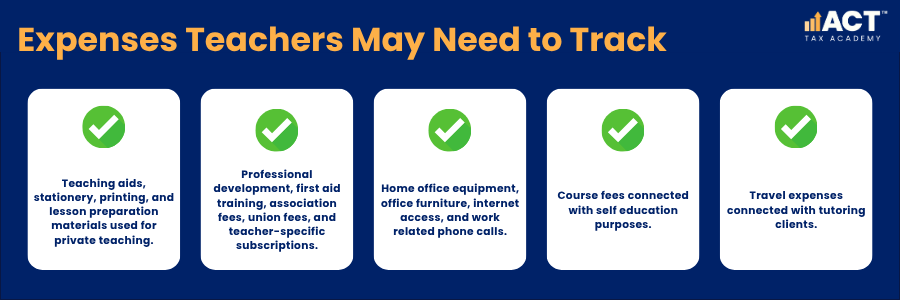
Common expenses can include:
- Teaching aids used for private lessons
- Professional development and first aid training connected with your teaching duties
- Professional association fees
- Professional publications, union fees, or teacher-specific subscriptions
- Home office equipment and office furniture
- Internet access charges and work related phone calls
- Course fees for self education purposes
- Travel expenses connected with tutoring clients
- Stationery, printing, and lesson preparation materials
Costs That Need Careful Separation
Some costs vary greatly depending on how they are used. These include mobile phones, internet costs, laptops, home office furniture, and office equipment. For example, if your mobile phone is used for personal calls, school messages, and tutoring bookings, your records should show the work related percentage. You may need a reasonable method, such as reviewing bills or keeping a short usage diary.
Home Office Expenses for Online Tutoring
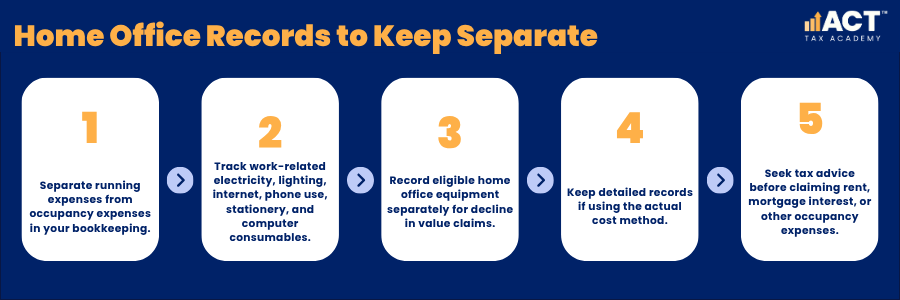
Home office expenses can be relevant when you prepare lessons, hold online tutoring sessions, complete admin, or manage private teaching records from home. Your bookkeeping should separate running expenses from occupancy expenses because they are not the same.
Running expenses may include the work-related portion of electricity, lighting, internet, phone use, stationery, and computer consumables. Under the fixed rate method, these costs are covered by the hourly rate, while the decline in value of eligible home office equipment may be claimed separately if the Australian Taxation Office (ATO) requirements are met. Occupancy expenses, such as rent or mortgage interest, are generally not claimable for employees working from home, but may be relevant in limited circumstances where part of the home is used as a place of business for private tutoring.
Running Costs and the Actual Cost Method
Running costs are the extra costs of working from home. These may include electricity for lighting, internet access charges, phone use, stationery, and computer consumables, while eligible equipment may be claimed through its decline in value.
Some teachers use the actual cost method when their records are detailed enough to show the additional running expenses incurred, the work-related use, and how the deduction was calculated. If you use the actual cost method, your system should show the hours worked from home, the costs incurred, the work-related use, and how you calculated the tutoring or employment portion.
Rent or Mortgage Interest Needs Caution
Rent or mortgage interest is generally not deductible for employees working from home, and it is not automatically deductible just because you mark assignments or deliver tutoring sessions from home. Mortgage interest and occupancy expenses require careful advice because claiming them for a home-based business may affect the CGT main residence exemption when the home is sold.
For many side-hustle teachers, the safer starting point is to track running expenses, home office equipment, and home office furniture clearly. Speak with a tax agent before claiming occupancy expenses.
Separating School Employment Expenses From Tutoring Expenses
School employment expenses and tutoring expenses should sit in different categories. A cost may relate to your teaching duties at school, your private tutoring work, or both, so your bookkeeping system should capture that difference. For example, parent teacher interviews, staff planning, and school trips usually relate to employment, while private lesson planning and student invoices relate to tutoring. Treating both as one category can make claiming deductions harder to support.
When an Expense Relates to Your Current Job
A work related expense for your current job should relate directly to your employment duties. This might include compulsory uniforms, protective clothing, teacher’s aid materials required for class, or professional development that maintains skills used in your current role. Some costs connected with school employment may still be private or non-deductible. Attending staff dinners, general fitness expenses, and everyday clothing are common examples where teachers should be careful.
When an Expense Relates to Private Teaching
A tutoring expense should relate to earning private teaching income. This may include lesson resources, online whiteboard software, tutoring advertisements, booking tools, and equipment purchased specifically for private lessons. For example, if you buy a document camera used only for online tutoring, the record should show the item, cost, date, and tutoring purpose. If it is used partly for school and partly for tutoring, your system should show the work related portion.
Managing Car Expenses and Travel Expenses
Car expenses can be relevant where travel is directly connected with tutoring or eligible work duties. Your records should show the date, destination, reason for the trip, kilometres travelled, and whether the trip relates to school employment or private teaching.
Teachers should be careful because normal travel from home to work is usually private. Travel may be treated differently when you travel directly between separate jobs on the same day, visit tutoring clients for business purposes, perform duties away from your usual workplace, or carry bulky equipment that is essential for your work, can only be transported conveniently by motor vehicle, cannot be securely stored at the workplace, and is not carried by choice.
When You May Claim Car Expenses
You may be able to claim car expenses where the travel relates directly to income-producing work. For tutoring, this might include driving from home to a client’s home for a private lesson, or travelling between tutoring locations on the same day, where the travel is directly connected with earning private teaching income. Your records should explain the teaching purpose of each trip. A logbook, diary, or spreadsheet can help support the work related percentage.
When You Cannot Claim Travel
You generally cannot claim ordinary travel between home and your regular school workplace. This remains private even if you check emails on the way or carry ordinary teaching materials, unless a specific ATO exception applies, such as carrying essential bulky equipment that can only be transported conveniently by motor vehicle, cannot be securely stored at work, and is not carried by choice. Travel for attending staff dinners, personal errands, or activities with only a loose connection to teaching should also be treated carefully. If the connection is unclear, record the detail and ask your tax agent before claiming.
Tracking Equipment, Depreciation, and Shared-Use Items
Equipment should be tracked separately from small everyday expenses because larger assets may need to be claimed over time. This can include laptops, tablets, printers, cameras, desks, chairs, lighting, microphones, and other home office equipment. Your system should record the purchase date, cost, supplier, business use, and whether the item is used for school employment, tutoring, or both. This is important for calculating depreciation and applying the diminishing value method where relevant.
Equipment Purchased Specifically for Tutoring
Equipment purchased specifically for private teaching is easier to record because the purpose is clearer. For example, a headset used only for online tutoring sessions can be entered under tutoring equipment. Keep the receipt, payment record, and a short note explaining how the item supports tutoring. This gives your tax agent enough detail to decide how the expense should be treated.
Shared Equipment Needs a Usage Split
Shared equipment needs a reasonable work-related percentage. A laptop used for school lesson planning, private tutoring, and personal streaming should not be treated as fully deductible. A practical method is to keep a representative usage record, such as a diary or log, where it reflects your usual pattern of use and supports the work-related portion claimed. For example, you may record 40% tutoring, 30% employment, and 30% private use if that reflects your actual pattern. Only the income-producing portions should be considered for deduction purposes, and the private-use portion should not be claimed.
Choosing a Spreadsheet or Accounting Software
A spreadsheet may be enough for a small tutoring side hustle with simple income and expenses. Accounting software becomes more useful when you manage invoices, online payments, GST, larger student numbers, or more complex deductions. As your tutoring work grows, it can also help you adapt if GST rate changes affect your business. The right choice depends on how often you teach privately and how much detail you need. The best system is the one you will update consistently.
When a Spreadsheet Works Well
A spreadsheet can work well if you teach a few students each week and receive payments by bank transfer. It should include separate tabs for income, tax deductions, equipment, car expenses, and home office expenses. Add a notes column for anything that needs explanation. This helps with costs that are partly private, partly employment related, or partly tutoring related.
When Software Is More Practical
Accounting software is more practical when your tutoring work becomes regular and organised. It can help you issue invoices, store receipts, track unpaid students, and review profit. Software can also help if you need clearer reports for your tax return. This is useful when your teaching side hustle grows beyond a small second job.

Build Practical Bookkeeping Skills
A strong bookkeeping system helps teachers separate school employment income, private teaching income, and common expenses with less stress. By tracking income, keeping detailed records, separating employment and tutoring costs, and reviewing work related expenses each month, you can make tax time more organised and easier to manage.
If you are ready to move from theory to practical application, the ACT Tax Academy Bookkeeping Online Course provides structured online training designed specifically for Australian small business owners and aspiring bookkeepers. You will learn how to set up and manage GST, choose between simplified and full GST reporting methods, prepare BAS, use Xero effectively, and implement compliant bookkeeping systems with confidence.