Building an Insolvency Dashboard in Xero or QuickBooks: Trading Insolvent KPIs for Bookkeepers
Building an “Insolvency Dashboard” in Xero or QuickBooks: KPIs Bookkeepers Can Use to Spot Trouble Early helps bookkeepers identify financial distress before it becomes harder to manage. Many businesses do not suddenly run out of money; the warning signs usually appear first in overdue invoices, unpaid debts, late tax payments, and incomplete financial records. For Australian bookkeepers, this dashboard is not about deciding whether a company is insolvent or giving legal advice under the Corporations Act.
Why an Insolvency Dashboard Matters for Bookkeepers
An insolvency dashboard matters because insolvent trading can expose company directors to serious consequences. In simple terms, insolvent trading occurs when a company incurs debts while it is insolvent, or becomes insolvent by incurring those debts, and there were reasonable grounds to suspect the company could not pay debts when due.
Bookkeepers are often close to the company’s finances because they process invoices, reconcile bank accounts, prepare Business Activity Statement (BAS) information, and review payroll. This means they may notice warning signs before directors, shareholders, or management personnel fully understand the company’s financial situation.
Early Detection Supports Directors Duties
Company directors have directors’ duties, including a duty to prevent insolvent trading. A bookkeeper does not take over those duties, but accurate bookkeeping can help directors make better decisions about the company’s business and company’s future.
The Dashboard Is a Support Tool, not a Legal Opinion
An insolvency dashboard should not state that a company failed or that a company is insolvent. Instead, it should show the financial position clearly so directors can immediately seek professional advice where needed.
This distinction matters because insolvency, insolvent trading claims, safe harbour protection, voluntary administration, small business restructuring, and external administration are legal and advisory areas. Bookkeepers can support the process by keeping adequate financial records, but they should not make formal insolvency decisions.
Setting Up the Dashboard Before Tracking KPIs
The dashboard must start with complete and reliable data. If bank accounts are not reconciled, supplier bills are missing, payroll liabilities are unclear, or tax accounts are not current, the dashboard may hide the true company’s financial position.
Before choosing Key Performance Indicators (KPIs), review the accounting file for incomplete financial records, duplicated transactions, old unreconciled items, missing loan or security agreement details, and unpaid ATO liabilities. A clean file gives directors and advisers a clearer view of company assets, company debts, secured creditor balances, unpaid PAYG withholding, unpaid GST, unpaid SGC, and unpaid employee entitlements.
Core Dashboard Sections
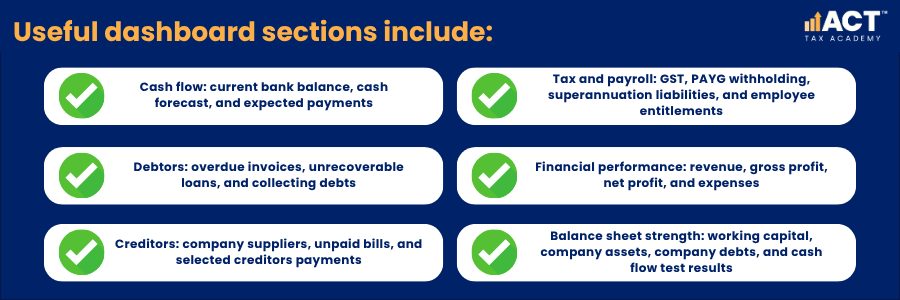
A practical insolvency dashboard should group information by the type of pressure it shows. This makes it easier for bookkeepers and company directors to discuss what is happening without using complex language.
Use Clear Risk Indicators
The dashboard should use simple labels such as green, amber, and red. Green means the position appears stable, amber means it needs attention, and red means the business should seek professional advice. For example, suppliers being paid outside usual terms may be amber. Solicitors’. letters, company suppliers placing accounts on hold, or a director penalty notice (DPN) from the Australian Taxation Office (ATO) may be red because these indicate a higher level of risk
Cash Flow KPIs That Show Immediate Pressure
Cash flow KPIs should sit at the top of the dashboard because a business must be able to pay debts when they fall due. A company may report a profit but still face financial distress if cash is locked in unpaid invoices or used to pay older debts. The cash flow test is a practical way to think about solvency. It asks whether the business can pay its own debts as and when they are due, not simply whether the market value of company assets is higher than company debts.
Cash at Bank and Minimum Cash Buffer
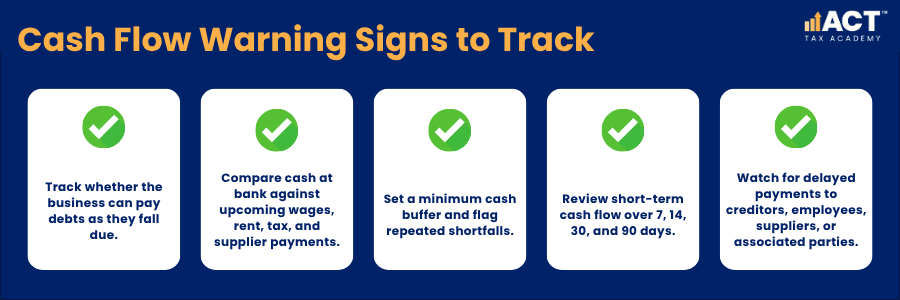
Cash at bank shows the amount currently available, but it only becomes meaningful when compared with upcoming payments. A company with $30,000 in the bank may still be under pressure if wages, rent, super guarantee obligations, overdue tax amounts, and supplier payments total $55,000 in the next fortnight. The dashboard should include a minimum cash buffer agreed with the business owner or accountant. If the business regularly falls below that amount, the bookkeeper should flag the issue and encourage the owner to seek advice.
Short-Term Cash Forecast
A short-term cash forecast shows expected cash coming in and cash going out over the next 7, 14, 30, or 90 days. This helps identify whether the company can meet company debts without delaying payments to associated parties, creditors, employees, or suppliers.
Debtor KPIs That Reveal Collection Problems
Debtor KPIs show whether customers are paying the business on time. Strong sales can still create financial difficulties if customers delay payment and the business keeps incurring new debt while waiting for cash to arrive.
Accounts Receivable Ageing
Accounts receivable ageing shows unpaid customer invoices by time period, such as current, 1–30 days overdue, 31–60 days overdue, and more than 60 days overdue. This report is one of the most useful early warning tools in Xero or QuickBooks.
Debtor Days
Debtor days measure how long customers take, on average, to pay invoices. A rising debtor days figure can show that cash is slowing down even when revenue looks steady. A simple formula is:
Debtor days = Accounts receivable ÷ Annual credit sales × 365
Creditor and Tax KPIs That Show Growing Pressure
Creditor and tax KPIs show whether the company is relying on unpaid debts to keep trading. When supplier bills, overdue tax amounts, GST, PAYG withholding, and SGC build up, the business may be using creditors, including the ATO, as a source of cash. This is a serious warning sign because some debts create personal liability risks for directors. A director may become personally liable for a company’s unpaid PAYG withholding, GST, and SGC under the ATO director penalty regime.
Accounts Payable Ageing
Accounts payable ageing shows how long supplier bills have remained unpaid. A growing balance in the 60-day or 90-day column can suggest that the business is not paying company suppliers on usual terms.
Tax, Super Guarantee, SGC, and Employee Entitlements
The dashboard should separate tax, super guarantee obligations, SGC, and employee entitlements from ordinary supplier bills. These amounts need close attention because unpaid PAYG withholding, GST, and SGC can create director penalty risks and affect directors, employees, and the company’s future.
If wages, super guarantee contributions, or employee entitlements cannot be paid on time, the business should seek professional advice promptly. If super guarantee is missed or paid late, the business may need to lodge a super guarantee charge statement and pay the SGC, and directors may face director penalty risks if SGC remains unpaid.
Balance Sheet KPIs That Show Financial Resilience
Balance sheet KPIs show whether the company has enough short-term assets to meet short-term liabilities. These indicators help bookkeepers see whether pressure is increasing across the company’s affairs, not just in the bank account. They are also useful when directors are managing companies through uncertainty. A clear balance sheet helps advisers review company assets, company debts, security agreements, unpaid debts, and likely options such as a company arrangement, small business restructuring, or voluntary administration.
Building the Dashboard in Xero or QuickBooks
Xero and QuickBooks can both support an insolvency dashboard using standard reports, saved report packs, and regular review routines. The aim is not to create a complicated system, but to make important financial information clear enough for directors and advisers to act. In Xero, start with the dashboard, aged receivables, aged payables, profit and loss, balance sheet, account transactions, and cash flow reports. In QuickBooks, use the dashboard, reports centre, aged receivables, aged payables, profit and loss, balance sheet, and cash flow tools.
When Bookkeepers Should Escalate Concerns
Prompt escalation can help directors understand options before an external administrator becomes necessary. Depending on the situation, options may include seeking professional advice, contacting the ATO before lodgments and payments are due, applying for an eligible payment plan, preparing a revised business plan, small business restructuring, voluntary administration, or another formal company arrangement.
Why Escalation Protects the Business
Early escalation can help directors prevent insolvent trading and make informed decisions. Where directors ignore warning signs, they may face civil penalties, compensation proceedings, director penalty action for unpaid PAYG withholding, GST, or SGC, or, in serious cases, civil and criminal penalties. In some situations, a director may become personally liable for certain company debts, including unpaid PAYG withholding, GST, and SGC under the ATO director penalty regime. This is why bookkeepers should not stay silent when the dashboard shows repeated financial distress.

Build Practical Bookkeeping Skills
If you are ready to move from theory to practical application, the ACT Tax Academy Bookkeeping Online Course provides structured online training designed specifically for Australian small business owners and aspiring bookkeepers. You will learn how to set up and manage GST, prepare BAS, use Xero effectively, and implement compliant bookkeeping systems with confidence.