
How to Use the Luxury Car Tax (LCT) Calculator for Your Small Business
Using a Luxury Car Tax calculator for your small business allows you to determine whether Luxury Car Tax (LCT) applies to your vehicle purchase and how much tax you may need to pay before you commit. If you are buying a new vehicle, comparing luxury cars, or considering imported vehicles, calculating the LCT amount early protects your cash flow and avoids unexpected costs.
Luxury Car Tax is part of the Australian tax system and is administered by the Australian Taxation Office. It applies when the GST inclusive value of the car exceeds the LCT threshold set for the relevant financial year. Understanding how to use a Luxury Car Tax calculator correctly ensures you know the true vehicle price excluding government fees such as stamp duty, compulsory third-party insurance, and transfer fees.
What Is Luxury Car Tax and When Does LCT Apply?
Luxury Car Tax (LCT) is a car tax charged when the value of the car exceeds the LCT threshold for the financial year. The Luxury Car Tax rate is 33% of the excess amount above that threshold.
From 1 Jul 2025, the higher threshold ($91,387) applies only to cars with combined fuel consumption ≤3.5 L/100km (many EVs qualify). If the vehicle meets the threshold for fuel efficient, the higher threshold applies before you need to pay LCT, but once exceeded, the same LCT rate applies.
Luxury Car Tax applies mainly to passenger cars, including new and imported vehicles, where the vehicle is designed primarily to carry passengers. It generally does not apply to certain commercial vehicles designed to carry goods, or to emergency vehicles such as police cars, fire trucks, and rescue vehicles, provided they meet specific criteria.
Why Small Businesses Should Use a Luxury Car Tax Calculator Before Buying
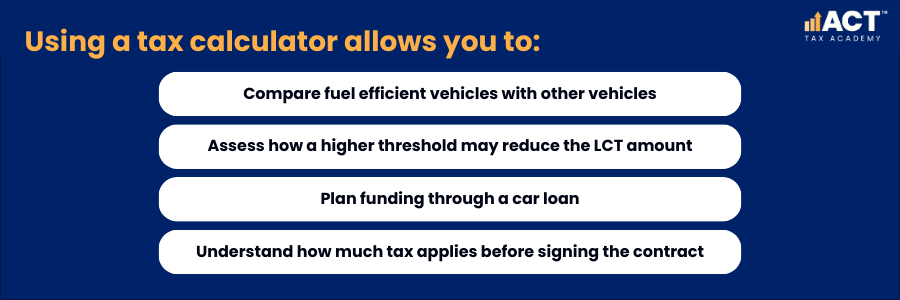
Before committing to your next vehicle purchase, you need clarity on how much tax applies to the retail price. A Luxury Car Tax calculator helps you calculate the LCT value based on the GST inclusive amount and determine whether you will need to pay LCT.
Many Australians focus on the advertised price of the car, but LCT remains a separate tax calculated on top of the GST inclusive value once the threshold is exceeded. Without running the numbers through an LCT calculator, you may underestimate the total cost of the vehicle purchase.ing, and creditors can request a meeting (including to consider replacing the liquidator). This approach allows directors to act before court liquidation becomes necessary.
How Does the Luxury Car Tax Calculator Work?
A Luxury Car Tax calculator uses a straightforward following formula to determine the LCT payable. The correct formula is: (GST-inclusive value − threshold) × 10/11 × 33%. In other words, subtract the threshold, remove GST (×10/11), then apply 33%.
To use an LCT calculator correctly, you typically enter the vehicle price, confirm whether the car qualifies as fuel efficient, and select the correct financial year. The calculator then shows the excess amount and the LCT amount so you can see exactly how much tax you need to pay.
This process provides clarity on the full vehicle purchase cost before including other Australian taxes such as stamp duty or transfer fees.

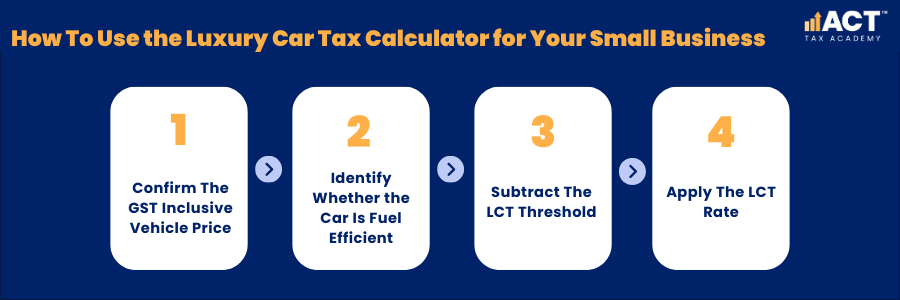
Step By Step: How To Use the Luxury Car Tax Calculator for Your Small Business
Using a luxury car tax calculator becomes straightforward when you follow a structured process. By working through each step carefully, you can calculate the LCT payable, understand how much tax applies, and avoid underestimating the total vehicle purchase cost.
The following steps show you exactly how to calculate the LCT amount using the GST inclusive value of the car and the correct LCT threshold for the financial year.
Step 1: Confirm The GST Inclusive Vehicle Price
Start with the GST inclusive value of the car. The LCT value is based on the price of the car excluding government fees such as stamp duty, compulsory third-party insurance, and registration.
For example, if the GST inclusive vehicle price is $95,000 excluding government fees, this is the amount used in the Luxury Car Tax calculator.
Step 2: Identify Whether the Car Is Fuel Efficient
Determine if the vehicle qualifies as a fuel-efficient car based on fuel consumption. Fuel efficient vehicles benefit from the higher LCT threshold, which may reduce the excess amount subject to LCT.
Electric vehicles often qualify as fuel efficient, which can make a difference when comparing luxury vehicles to other cars.
Step 3: Subtract The LCT Threshold
Once you confirm the correct threshold set for the financial year, subtract it from the GST inclusive value of the car. If the value of the car exceeds the threshold, LCT applies only to the excess amount.
For the 2025–26 year, the LCT thresholds are $80,567 (standard) or $91,387 (fuel‐efficient). For example, if the GST-inclusive price is $95,000, the excess is $14,433 (standard threshold) or $3,613 (if fuel-efficient).
Step 4: Apply The LCT Rate
Multiply the excess amount by the LCT rate of 33%. In this example, $18,050 multiplied by 33% results in an LCT amount of $5,956.50.
This is the Luxury Car Tax payable on the vehicle purchase.
How LCT Applies to Imported Vehicles
If you import luxury cars into Australia, Luxury Car Tax may apply in addition to customs duties and GST. For individuals importing or businesses bringing in new and imported vehicles, the LCT value is calculated based on the customs value plus certain transport and insurance costs.
For imported vehicles, businesses (GST-registered importers/dealers) report LCT on their BAS, while private importers generally pay LCT at customs clearance. This makes it essential to use a Luxury Car Tax calculator before committing to import luxury cars, especially where the vehicle price is close to the higher threshold and interacts with other obligations such as GST withholding compliance requirements.
Imported luxury vehicles can attract multiple layers of tax, so planning early avoids unexpected liabilities.
When Luxury Car Tax Does Not Apply
LCT generally does not apply to commercial vehicles intended mainly for goods. For example, trucks/vans with >2t payload (or 9+ passenger seats) are exempt.
LCT is exempt for certified emergency vehicles (ambulances, fire, police, rescue, etc.). Primary producers and tourism operators still pay LCT initially, but the ATO allows refunds (up to $10,000 per eligible vehicle) for certain work vehicles
However, most standard passenger vehicles, including high-end SUVs and electric vehicles used for personal use or mixed business use, will fall within the LCT rules if the value exceeds the threshold set.
How LCT Interacts with GST And Business Deductions
Luxury Car Tax is separate from GST, but both are calculated within the broader tax system. If your business is registered for GST, you may claim the GST component as an input tax credit, subject to the car limit for depreciation, so it is important to understand how to calculate GST for Australian businesses accurately.
Even if you pay Luxury Car Tax, your deduction may be capped at the car limit, meaning the full value of the car cannot always be claimed. This is particularly relevant where the vehicle is used partly for personal use, and it also interacts with broader planning opportunities such as small business CGT concessions when selling business assets.
Understanding how LCT applies alongside GST ensures you report correctly and avoid errors when you report and pay through your Business Activity Statement (BAS).
Common Mistakes When Using a Luxury Car Tax Calculator
Small errors can result in underestimating how much tax you need to pay. Common issues include using a price of the car that excludes GST, including stamp duty in the LCT value, or applying the wrong threshold for fuel efficient vehicles, similar to the kinds of GST reporting mistakes outlined in guides on avoiding BAS lodgement errors and compliance issues.
Another common mistake is assuming that LCT payable automatically increases your tax deductions. While LCT remains part of the cost base, depreciation limits may restrict your claim, just as rules around small business capital gains tax concessions can limit or enhance the overall tax benefit when assets are sold.
Using the correct GST inclusive value and confirming the correct financial year threshold reduces the risk of mistakes, especially when paired with a structured BAS lodgement checklist for small businesses.

Planning Your Next Vehicle Purchase with Confidence
Using a Luxury Car Tax calculator before your next vehicle purchase gives you clarity on how much tax applies and whether you will need to pay LCT. It allows you to compare luxury cars, fuel efficient vehicles, commercial vehicles, and imported vehicles based on their full tax impact.
Before you sign a contract or arrange a car loan, confirm the GST inclusive vehicle price, check whether the higher LCT threshold applies, calculate the excess amount, and determine the LCT amount. This ensures your decision aligns with your cash flow and overall business strategy.
If you are unsure how Luxury Car Tax applies to your situation, or you want support reviewing your numbers before you pay LCT or lodge your BAS as a business owner, we are here to help you make informed and confident decisions for your business.