
Medicare Levy Surcharge Explained: Who Pays, How Much, and Why It Matters for High-Earning Small Business Owners
Medicare Levy Surcharge Explained: Who Pays, How Much, and Why It Matters for High-Earning Small Business Owners is all about understanding when you may have to pay extra tax and how to avoid paying more than you need to. As your annual taxable income grows, this surcharge can be the difference between a smooth tax time and a nasty surprise. With the right planning around private hospital cover and your income thresholds, you can keep more of your profit working for you.
High-earning small business owners often sit above a certain income, which means they may have to pay the Medicare Levy Surcharge (MLS) if they do not hold hospital cover at the appropriate level. The surcharge aims to encourage individuals on higher incomes to use the private system instead of relying only on the public system. If you understand how the levy surcharge works, you can make informed decisions that support both your health and your cash flow.
What Is the Medicare Levy Surcharge and Who Pays It?
The Medicare levy surcharge is an extra tax that applies to Australian taxpayers whose income for MLS purposes is greater than the set income thresholds and who do not hold private hospital cover. It sits on top of the standard 2% Medicare levy that most Australian taxpayers already pay. The surcharge is calculated after the end of the financial year when you lodge your tax return.
You may have to pay the MLS if your income, or your combined income with a spouse, goes over the relevant threshold and you do not have approved hospital cover for the full financial year. The surcharge covers you, your spouse and your family, including each dependent child who is taken into account for MLS purposes. If you are a prescribed person who is exempt from Medicare, different rules can apply, and you may not pay the Medicare levy or surcharge.
How Much Is the Medicare Levy Surcharge and How Is It Calculated?
If you are wondering how much is the Medicare levy surcharge, it depends on which income tiers you fall into. MLS rates usually range from 1% to 1.5% of a certain amount related to your income for MLS purposes. This is separate from how much tax you pay under the normal tax scales.
| Category | Tier | Singles – Income For MLS Purposes | Families – Income For MLS Purposes |
|---|---|---|---|
| Base | No MLS | $101,000 or less | $202,000 or less |
| Tier 1 | MLS 1% | $101,001 – $118,000 | $202,001 – $236,000 |
| Tier 2 | MLS 1.25% | $118,001 – $158,000 | $236,001 – $316,000 |
| Tier 3 | MLS 1.5% | $158,001 or more | $316,001 or more |
The 2025–26 thresholds have increased from the 2024–25 year, when singles paid MLS above $97,000 and families above $194,000. For surcharge purposes, your income thresholds and rates are set out by the Australian government and updated by the Australian Taxation Office. The surcharge is calculated on a daily basis over the financial year, so even part‑year gaps in private hospital insurance can trigger a charge. Many business owners use a Medicare levy surcharge calculator or work with a financial planner or tax adviser to estimate how much they might pay.

What Income Counts for Medicare Levy Surcharge Purposes?
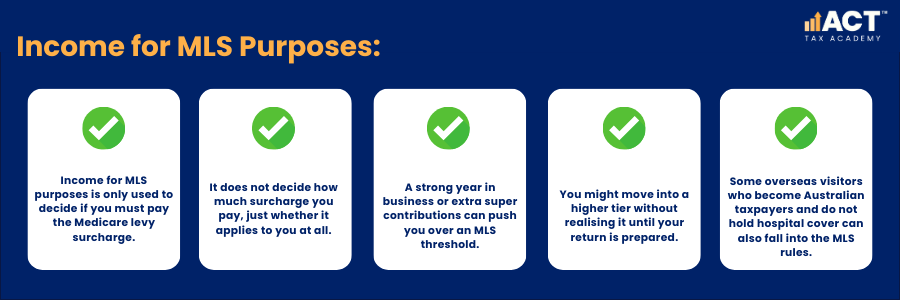
For Medicare levy surcharge purposes, income is wider than just your annual taxable income from your business or job. Income for MLS purposes generally starts with your taxable income and then adds things like reportable fringe benefits, some reportable super contributions and any net investment losses. This means your MLS purposes total can be greater than your taxable income figure.
Your combined taxable income and these extra components are used to work out whether you pass the family income threshold or single income threshold. For families, combined income includes both partners’ income for MLS purposes and may also include some amounts related to each MLS dependent child. This is why some owners who feel they earn a “certain amount” end up in a higher bracket than expected.
How Do Family Income Thresholds and Dependants Work?
The family income threshold and income thresholds and rates for MLS differ from those for a single person. If you have a spouse or family, your combined income is tested against the family tiers rather than the single tier. Single parent families and de facto couples are usually treated in the same way as married couples for these tests.
The family income threshold increases when you have more children. For MLS, the family income threshold increases by 1,500 dollars for each MLS dependent child after the first child. That means each child after the first child can push up the threshold at which you start to pay the surcharge.
- A dependent child for MLS purposes includes a child who is under 21 years old, or 21 to 24 years old and studying full-time at school, college or university.
- If your combined taxable income crosses the family threshold, you may have to pay the surcharge even if only one partner’s income jumped.
- Always check how your family income and personal circumstances affect your position each financial year.
What Kind of Private Health Cover Do You Need to Avoid Paying MLS?
To avoid the Medicare levy surcharge, you generally need to hold hospital cover with a registered insurer for the full financial year. This is sometimes called private hospital cover or private hospital insurance, and it is different from having only extras cover such as dental or optical. The policy must be an appropriate level of health cover with an excess that falls within the rules set by the government.
If you and your family are covered by approved hospital cover for each day of the year, you normally will not pay the MLS, even if your income sits above the income thresholds. Some policies attract the private health insurance rebate, which is a government rebate that helps reduce the cost of premiums for eligible Australian taxpayers. The right policy can sometimes cost less than the Levy that would apply if you stayed only in the public system.

How Does the Medicare Levy Surcharge Work for Singles Versus Families?
A single person who crosses the single income threshold and does not have private hospital insurance may have to pay the MLS on their own income. For singles, it is usually easier to track income against the thresholds and decide whether to hold hospital cover. Many single business owners use the income thresholds chart or an online calculator to see how much they might pay.
For families, the rules are based on the combined income of both adults and, in some cases, the family income including extra amounts for each child. Single parents, de facto couples and couples with more than one child are all treated under the family tiers. In these situations, it is important to think about the whole family position rather than just one person’s tax.
How and When Is the Levy Surcharge Applied at Tax Time?
The Australian Taxation Office works out whether you need to pay the Medicare levy surcharge when you lodge your tax return. Question M2, often called Medicare levy surcharge (MLS) on the return, asks you about hospital cover and the days you were covered. Based on your income for MLS purposes and your cover details, the surcharge is calculated and added to how much tax you must pay.
If you held hospital cover for part of the year, you may have to pay the MLS for the remaining days when you were not covered. The surcharge figure appears on your notice of assessment and can come as a shock if you did not plan ahead. This is why many business owners work with a financial planner or accountant before 30 June to estimate the impact and avoid paying more than needed.
Why Does the Medicare Levy Surcharge Matter for High-Earning Small Business Owners?
For small business owners with strong profit, the surcharge can turn into a significant extra tax if it is ignored. A higher annual income from your business, plus other income, can quickly push you into higher tiers, especially in good trading years. Because the MLS is in addition to the normal Medicare levy and other tax, it can noticeably increase how much tax you pay in total.
Your personal circumstances, family situation and business structure can all influence your MLS position. For example, a company bonus, trust distribution or capital gain in one financial year may push your income above a threshold when your normal earnings would not. By planning around these events, you may be able to smooth your income and pay less tax over time.
What Practical Steps Can You Take to Manage or Avoid MLS?
If you want to avoid paying the MLS, start by checking your expected income for MLS purposes for the current financial year. Include your taxable income from the business, any wages, reportable super contributions, fringe benefits and investment income. If that total looks likely to pass the relevant threshold, consider whether it makes sense to take out or maintain private hospital cover.
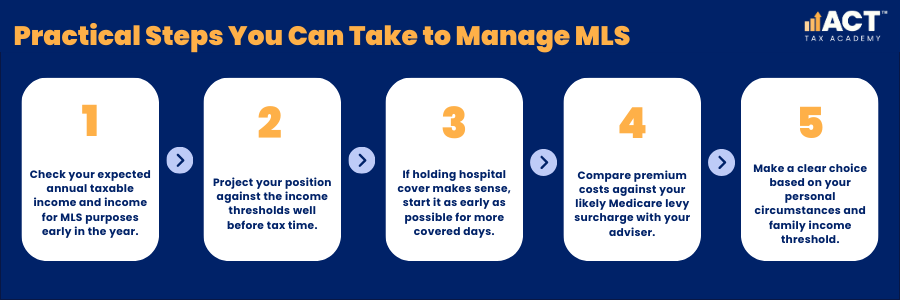
Next, review your family situation and who is covered. If you have a spouse, child or MLS dependent child, look at your combined income and whether everyone is covered under one policy. Where it suits your overall goals, a financial planner or accountant can help you restructure drawings, adjust super contributions or time one‑off payments so your income stays within a chosen tier.