Medicare Levy 101: What Australian Small Business Owners Need to Know About the 2% Charge
Medicare Levy 101: What Australian Small Business Owners Need to Know About The 2% Charge is all about understanding how much Medicare levy is and how it fits into your total taxable income and cash flow. The Medicare levy is generally 2% of your annual taxable income and is worked out when you lodge your tax return with the Australian Taxation Office. Many small business owners only realise they may have to pay more when their income rises and the Medicare levy surcharge also becomes relevant.
The Medicare levy sits alongside normal income tax and depends on your income thresholds, family income and personal circumstances. It is separate from the Medicare levy surcharge, which can apply if your income is above a certain amount and you do not have appropriate private hospital cover. Getting clear on both the levy and the surcharge helps you avoid paying more than expected and plan ahead across each financial year.
What Is the Medicare Levy and How Much Is The 2% Charge?
The Medicare levy is an extra tax that helps fund Medicare and Medicare benefits, and most Australian taxpayers pay the Medicare levy at a rate of 2% of their annual taxable income. It is calculated on your tax return once your income is above the low-income thresholds and you do not qualify for a Medicare levy exemption or Medicare levy reduction. In simple terms, if your taxable income is $80,000, the standard levy would be $1,600.
When you calculate your tax, the levy is added after your normal income tax, so it is important to factor it into your total tax bill. The levy can be reduced or removed if your income is below certain income thresholds, or if you are eligible for special rules such as the seniors and pensioners tax offset. The Australian Taxation Office provides updated thresholds and examples each year so you can see how your income and family situation affect what you pay.
How Does the Medicare Levy Apply to Small Business Owners?
For small business owners, the Medicare levy is based on your personal tax return, not your business bank account. Sole traders include their business profit in their annual taxable income, while company or family trust owners include salary, dividends or family trust distribution tax amounts they receive. This means the way you pay yourself from your business can change how much Medicare levy you pay.
If you are a single person operating as a sole trader, your net business income flows straight into your individual return, and the levy is calculated on that income after other tax adjustments. If you are in a family with a spouse and dependants, your family income and combined income may affect reductions or thresholds, especially where family income threshold increases apply per dependent child. Your structure does not remove the levy; it just changes which amounts are counted as your taxable income.
What Income Thresholds, Reductions and Exemptions Should You Know?
The Medicare levy uses income thresholds to decide whether you pay the full levy, a reduced rate or no levy at all. If your annual taxable income is below the lower threshold, you may receive a full Medicare levy exemption and pay none. For 2025–26, if your income as a single person sits between $27,222 and $34,027 (or $43,020 to $53,775 if you qualify for the seniors and pensioners tax offset), you pay only part of the levy.
Families have their own family income threshold, and the family income threshold increases with each dependent child or other dependants. Seniors and pensioners tax rules and the pensioners tax offset can also lift the thresholds, which helps many retirees and low-income seniors pay less or avoid paying the levy. To claim certain exemptions, such as when you were a foreign resident for part of the year or did not have Medicare entitlement, you may need a Medicare entitlement statement.

What Is the Medicare Levy Surcharge (MLS) And How Is It Different?
The Medicare Levy Surcharge (MLS) is an extra charge that may apply if your income is above a certain amount and you do not have appropriate private health cover, specifically private hospital insurance. While the Medicare levy is 2% for most people, the MLS can add a further 1% to 1.5% of income for MLS purposes. In other words, you may have to pay the Medicare levy and also pay the MLS if you meet the following criteria.
For a single person in 2025–26, the surcharge starts once your income for MLS purposes passes $101,000, with rates increasing across three tiers up to $158,001 and above. For families in 2025–26, the base threshold is $202,000, increasing by $1,500 for each dependent child after the first. If your family income crosses a certain amount, you may have to pay the MLS even if one spouse earns less, because combined income is what matters for MLS purposes.
How Do Private Health Cover and Hospital Cover Affect The MLS?
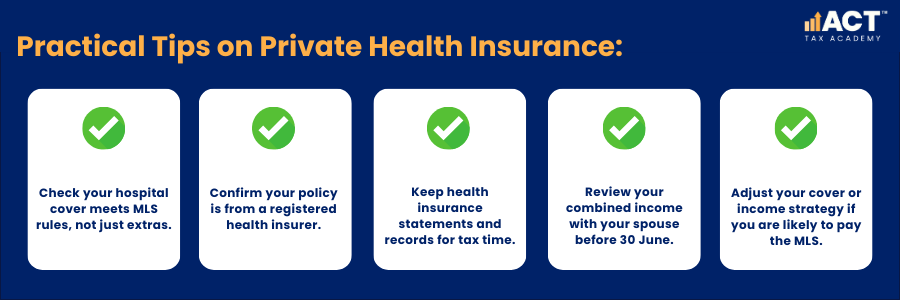
To avoid paying the Medicare levy surcharge, you generally need private health insurance that includes private hospital cover with an appropriate level of hospital treatment. Extras-only health insurance is not enough; you must hold hospital cover or private patient hospital cover with a registered health insurer. If your income is above the threshold and you do not have qualifying cover, you may have to pay MLS on top of the standard levy.
Your policy must meet specific rules to be treated as an appropriate level of hospital cover for MLS purposes, and you usually need to hold it for the full financial year to avoid paying the MLS. If your cover starts or stops mid-year, you may pay MLS for part of the year or part of your income, depending on the timing. Single parents, couples and families all need to check how their combined income and policy setup affect whether they will pay the Medicare levy surcharge.
Who Can Claim a Medicare Levy Exemption or Reduction?
Not everyone has to pay the full levy, and in some cases, you may avoid paying it or pay only a reduced rate. A Medicare levy exemption means you do not pay the levy for the relevant period, often because you were not entitled to Medicare benefits or were a foreign resident. To prove this, you may need documents such as a Medicare entitlement statement, especially if you relied on health insurance from another country or were overseas for an extended time.
A Medicare levy reduction applies when you earn above the lower income threshold but below the full-rate threshold, so you pay only part of the levy. Families, seniors and those who qualify for the seniors and pensioners tax offset often benefit from these reduction rules. Your personal circumstances, including your spouse, dependants and family income, are all taken into account when deciding whether a reduction or exemption applies.

How Do Family Situations, Dependants and Spouses Affect the Levy?
Family situations can change both the Medicare levy and the Medicare levy surcharge. If you have a spouse, your combined income can affect whether you pay MLS and how family income thresholds work. Families with more than one dependent child often see their family income threshold increase, which can reduce the levy or help avoid paying MLS.
Dependants include each dependent child and, in some cases, other dependants such as a student you support. A single parent is often treated under family rules, which means family income thresholds and combined income rules can still apply even if there is only one adult. Your spouse’s income, along with your own, is used for certain calculations, so both partners’ income and cover need to be considered when planning around MLS and the levy.
What Should Small Business Owners Do to Plan Ahead?
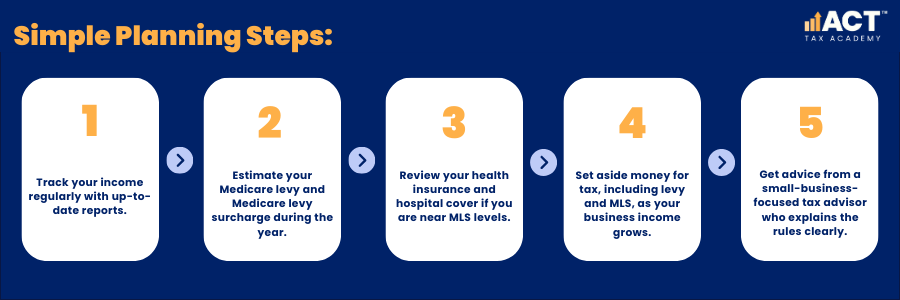
For small business owners, planning around the levy and surcharge starts with understanding your expected income and how it flows through to your tax return. Because business income can jump from year to year, a profitable year can push your income over an MLS threshold or remove your access to a reduced rate. Taking time to estimate your annual taxable income during the year helps you calculate likely levy and MLS amounts in advance.
It can also be useful to set aside money for tax, including the levy and any surcharge, whenever you pay yourself or receive distributions. If you expect your income to be above the MLS thresholds, reviewing your private health cover and hospital cover options before year-end can help you avoid paying the MLS or part of it. Practical, steady planning means the levy and surcharge become manageable parts of your overall tax, rather than an unwelcome surprise.
Why Understanding Medicare Levy and MLS Matters for Your Financial Future
Understanding the Medicare levy, the surcharge and the way they interact with your business income gives you a clearer view of your real after-tax position. When you know how much Medicare levy you will pay in your circumstances, you can make better choices about drawings, distributions and investments back into your business. It also makes it easier to compare health insurance options and decide whether private patient hospital cover is right for you and your family.
For many small business owners, these rules can feel complex at first, especially when family income, dependants and changing thresholds are involved. With the right support and clear explanations, the levy, surcharge and related reductions become practical tools you can plan around, rather than a source of stress. Taking time now to understand how they work gives you more control over your tax and more confidence in your long-term financial decisions.