How to Track and Report Personal Service Income for Tax Compliance
Knowing how to track and report Personal Service Income (PSI) for tax compliance is vital for anyone providing personal services in Australia. Whether you are a sole trader, company, partnership, or trust, following the Personal Services Income (PSI) rules ensures that your income tax return is accurate and you stay compliant with the Australian Taxation Office (ATO). This article will address common challenges related to PSI, explain who the PSI rules apply to, and provide straightforward strategies to manage, track, and report PSI across almost any industry.
Understanding PSI: The Challenge for Small Businesses
PSI is income generated mainly from your personal efforts, skills, or knowledge. The PSI rules apply if more than half the reward you receive from a contract is directly related to the work performed by you as an individual, not from the use of business assets, selling finished goods, or income producing assets. Many businesses, from IT consultants to health professionals, may unknowingly earn PSI without realising the PSI rules may apply.
Failing to properly identify PSI can mean missing out on allowable tax deductions, facing unexpected tax obligations, or risking penalties if you misclassify your income in your income tax return. When these rules apply to your circumstances, you need to follow specific steps to ensure your income is classified correctly for the ATO.
What is PSI and Who Does It Affect?
PSI applies to income received for personal services, where the main reason clients pay is for your individual abilities rather than for selling goods or the value of an income producing asset such as equipment or intellectual property. Common examples include consulting fees, contract work, professional advice, and freelance services across a wide range of industries.
PSI can be earned by a sole trader, company, partnership, or trust. If your entity receives PSI, you must self-assess every year to check if PSI rules apply. If you operate in a way where your business structure isn’t the main factor in generating income, you may need to declare PSI and follow additional steps in your tax return.
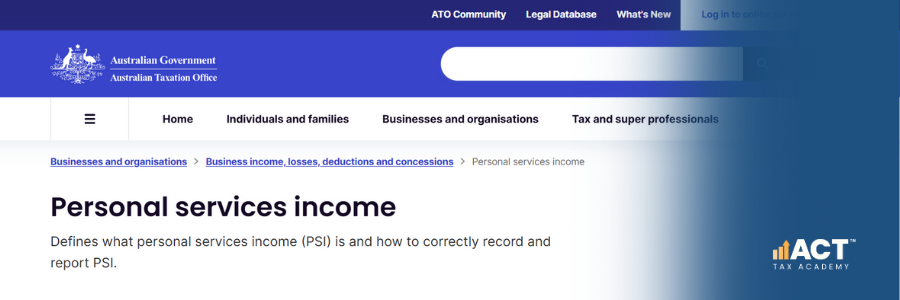
How to Determine If You Have PSI
To test if an individual’s PSI rules apply, you’ll first look at the percentage of income generated from your personal efforts or skills. The ATO provides specific Personal Service Income (PSI) rules and a results test. This test checks if your income is paid for a specific result, if you are liable for defects, and if you provide your own equipment or tools. If you meet the requirements, you may be classified as a Personal Services Business (PSB).
A Personal Services Business (PSB) determination may exempt you from some PSI rules if you can show you pass the results test or other business-related criteria, such as the unrelated clients test, employment test, or business premises test. If you only have one client or income from just one source, you might not qualify as a PSB, and all PSI rules may apply to you.

Effective Strategies to Track, Report, and Manage PSI
Managing PSI does not need to be overwhelming. By putting organised systems in place early, you can track PSI, avoid errors, and claim deductions you are entitled to, while ensuring your reporting is accurate for each tax year.
Keeping Good Records
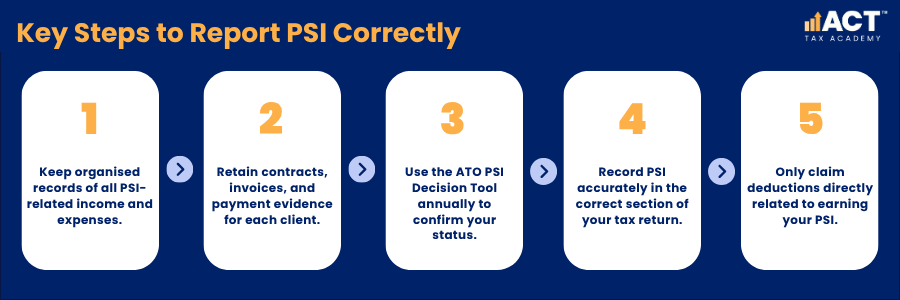
Accurate record-keeping is crucial. Keep copies of all contracts, invoices, and payment records that relate to personal services or work performed. You should also retain evidence of any tools, equipment, or intellectual property used in earning your PSI. If you are charged account keeping fees or bank fees tied to your business income, include these in your business records, as they may affect your deductions.
If you pay wages to employees or associates to help deliver your principal work, ensure all payments and their relation to the work performed are clearly documented. This becomes important if you claim deductions or wish to demonstrate you are running a PSB.
Using the PSI Decision Tool
The ATO offers a PSI decision tool to help you self-assess whether your income is PSI and if the rules apply. Gather all supporting documentation before using the tool: this includes contracts, summaries of income received, and details relating to work performed for each client. The tool’s results help you determine if you qualify for a PSB determination or if PSI rules limit the deductions you can claim.
Whether you are a sole trader or operate through a personal services entity, it’s essential to complete this self-assessment each year. If you have a PSB determination in place, maintain a copy with your tax records.
Reporting PSI in Your Tax Return
When reporting PSI, include all relevant details in your income tax return. State the income received as PSI, clearly noting if any was earned via a company, partnership, or trust (personal services entity). Enter all required information in the “Personal Services Income (PSI)” section. Remember, if PSI rules apply, only certain deductions can be claimed — usually the same as those available to an employee.
If eligible, claim deductions for costs directly tied to earning your PSI, such as account keeping fees, bank fees, and the cost of equipment directly related to work performed. Costs not connected to delivering personal services, such as income producing asset expenses unrelated to your personal efforts, typically cannot be claimed.
Common Mistakes and How to Avoid Them
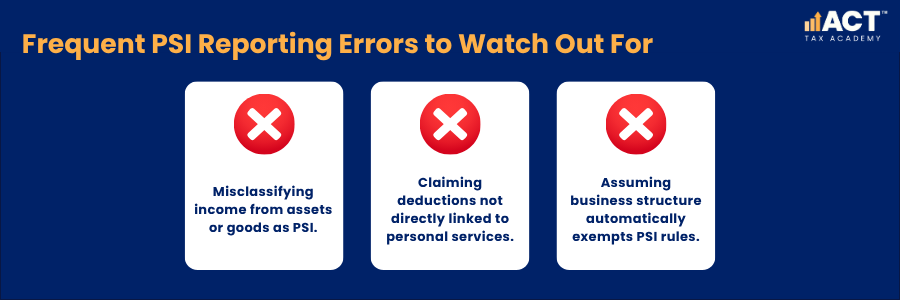
Many businesses misclassify income or claim deductions for expenses not allowed under the PSI rules. Common errors include:
- Reporting income that is actually derived from business assets or finished goods as PSI.
- Attempting to claim deductions for costs not directly connected to the delivery of personal services, such as unrelated business expenses.
- Assuming that all income generated under your business structure exempts you from the PSI rules.
To avoid these errors, regularly review your records, ensure you use the ATO’s PSI tool, and keep all relevant documentation so you can clearly demonstrate the relation between income and your personal skills. If your business circumstances change, such as expanding to serve more clients or adding more employees, reassess whether the rules apply and adjust your processes.
Conclusion
Personal Services Income (PSI) is a key tax compliance area for many business owners, sole traders, and professionals across Australia. Keeping on top of these rules will help you avoid unnecessary stress, ensure your reporting matches the requirements set by the Australian Taxation Office (ATO), and let you claim deductions you’re rightly entitled to.
Track all income produced through your personal efforts, maintain detailed and accurate records, and self-assess using the tools provided by the ATO. By doing so, you’ll position yourself for a stress-free tax season and reduce the likelihood of mistakes or unnecessary pay tax notices.
If you’re unsure about any step in tracking or reporting PSI—whether it’s identifying if PSI rules apply to your circumstances, submitting your income tax return, or understanding new PSB determination eligibility—it’s always best to seek professional advice from an experienced accountant familiar with your industry. Are you ready to get PSI compliance right and take the worry out of your next tax return? Start today and make the most of your hard work by staying informed and organised.