
Common Trust Bookkeeping Mistakes Small Businesses Make
Common trust bookkeeping mistakes small businesses make include mixing personal and trust money, recording beneficiary payments incorrectly, overlooking the trust deed and failing to reconcile important accounts. These errors can affect tax returns, distort financial reports and make formal yearly administrative tasks more difficult. A trust is a legal arrangement where a trustee holds and manages property or assets for beneficiaries. The trustee is responsible for administering the trust according to the trust deed and applicable law, including managing its tax affairs, so accurate bookkeeping is essential.
Understanding What is a Trust Before Recording Transactions
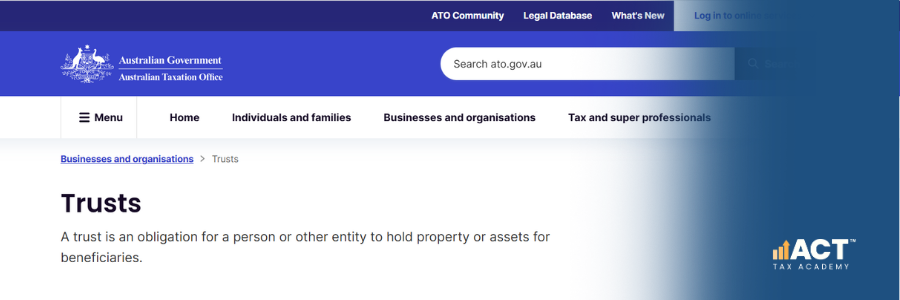
To understand trust bookkeeping, it helps to first understand what a trust is. A trust is not a separate legal person in the same way as a company, but it can operate a business, hold business assets, receive income and pay expenses.
Common Types of Trusts Used in Australia
In a discretionary trust, the trustee decides which beneficiaries receive income or capital, in line with the trust deed. A family trust is a common type of discretionary trust used by family groups for business, investment, succession and tax planning purposes. A fixed trust gives beneficiaries a set interest in the trust property, while a unit trust divides ownership into units. Other arrangements include testamentary trusts created through a will, charitable trusts, private trusts and inter vivos trusts established while the person making the trust is alive.
Mixing Trust Money with Personal Transactions
One of the most common mistakes is using the trust bank account for personal spending. Paying a family member’s private bill, depositing unrelated personal money or withdrawing funds without a clear explanation makes it difficult to identify genuine trust activity. The trust should have a separate bank account used for its own income, expenses and assets. This separation supports clear trust administration and helps show that the trustee is meeting their legal obligation to manage trust assets responsibly.
Record Personal Withdrawals Correctly
A personal payment does not become a business expense simply because it was paid from the trust bank account. It may need to be recorded as a beneficiary payment, a loan, a distribution or money owed back to the trust. For example, if a beneficiary uses trust money to pay a private household expense, the bookkeeper should not record it as office supplies or another deductible cost. The transaction must show who received the benefit and why the money was paid.
Recording Beneficiary Payments as Business Expenses
Payments to beneficiaries are often incorrectly coded as wages, contractor costs or general expenses. A beneficiary payment is not automatically tax-deductible just because the trust paid money to that person. The correct treatment depends on whether the payment was a distribution, reimbursement, loan, repayment or genuine payment for work performed. Each type of payment should be recorded separately so the accounts show what happened.
Separate Distributions from Cash Payments
A trust distribution is an allocation of income generated by the trust. It does not always match the amount of cash a beneficiary received during the year. For example, a named beneficiary may receive $20,000 during the year but later become entitled to $35,000 of trust income. The records should show the full entitlement, the amount already paid and the remaining balance.
Review Overdrawn Beneficiary Accounts
A beneficiary account may become overdrawn when the person receives more money than the amount currently recorded as payable to them. The balance may represent a loan, an advance against a later entitlement or another transaction, so it should be reviewed and recorded according to its actual nature. These balances should not remain unexplained. The trustee and adviser may need to decide whether the amount must be repaid, formally documented or treated in another way.
Failing to Reconcile Beneficiary Accounts
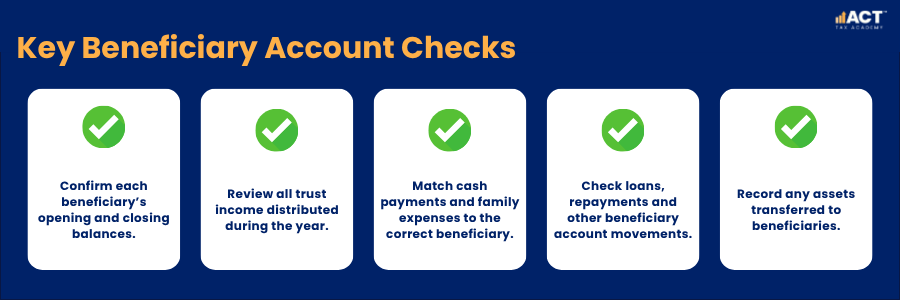
A balanced bank account does not confirm that beneficiary records are correct. Distribution accounts, loans, unpaid amounts and personal payments can still contain errors even when the bank reconciliation is complete. Each beneficiary account should agree with the trust deed, trustee decisions, prior-year balances and financial statements. This helps protect beneficiaries from incorrect tax reporting and prevents the same payment from being recorded twice.
Ignoring the Trust Deed During Bookkeeping
The trust deed is the main legal document that controls how the trust operates. Bookkeepers should not make assumptions about distributions, asset ownership or beneficiary entitlements without understanding the rules in the deed. A formal trust deed may explain who can receive benefits, how the trustee decides to distribute income and whether certain types of income can be treated separately. The bookkeeping records must support those rules.
Identify Different Types of Income
Trust income may include business income, rent, interest, dividends, capital gains and income received from other trusts. Recording all income in one general account can make tax planning and year-end decisions harder.
Confirm Who Can Receive a Benefit
Not every family member or related person is automatically a beneficiary. The deed may list a named beneficiary and define other beneficiaries by relationship, company ownership or another category. The trustee owes duties to all beneficiaries of the trust and must act within the deed. Payments to someone outside the permitted group may create legal, tax and bookkeeping problems.
Leaving Distribution Decisions Until After Year-End
In a discretionary trust, the trustee decides how trust income will be distributed within the powers provided by the trust deed. A resolution intended to make beneficiaries presently entitled to trust income generally must be made by 30 June of the relevant income year, or by an earlier date if the trust deed requires it. Poor bookkeeping can prevent the trustee from knowing how much income the trust has earned. If bank accounts, invoices and beneficiary records are incomplete, the trustee may make a decision based on inaccurate figures.

Prepare Current Accounts Before Year-End
The bookkeeper should reconcile the trust bank account, check outstanding invoices, review asset purchases and investigate unusual payments before the end of the financial year. This gives the trustee and adviser better information for tax planning. The trust should have its own Tax File Number (TFN), which the trustee uses when lodging the trust tax return. For a closely held trust, beneficiaries should quote their TFN before receiving a payment or becoming entitled to trust income, as withholding obligations may otherwise apply; from 1 July 2026, beneficiary TFNs are reported in the statement of distribution in the annual trust tax return.
Match Bookkeeping Entries to Trustee Decisions
Once the trustee has made the distribution decision, the bookkeeping entries should follow it exactly. The bookkeeper should not divide income equally unless the trustee has actually decided to do so. The beneficiary accounts, financial statements and tax returns should all show consistent amounts. Differences may indicate that the resolution, journal entries or cash payments need further review.
Mismanaging Unpaid Beneficiary Entitlements
An Unpaid Present Entitlement (UPE) can arise when a beneficiary is presently entitled to trust income but the amount remains unpaid. The balance should be tracked separately, and arrangements involving a private company beneficiary, such as a bucket company within an Australian trust structure, should be reviewed because Division 7A may apply where trust funds or other benefits are provided to the company’s shareholders or their associates. Each balance should show the beneficiary, the relevant financial year, the amount distributed, payments made and the amount still owing. Combining several years into one figure makes the records harder to review.
Avoid Clearing Balances Without Evidence
A balance should not be removed simply because it has remained in the accounts for several years. The records should show whether it was paid, repaid, offset or formally dealt with.
Claiming GST Without Checking the Transaction
A trust registered for Goods and Services Tax (GST) must apply the correct treatment to each transaction. Common errors include claiming GST credits for private purchases, claiming credits where GST was not included in the price and failing to hold a tax invoice for purchases costing more than $82.50, including GST, unless an ATO exception applies. These mistakes can affect the Business Activity Statement (BAS) and create additional work when the accounts are reviewed, especially when the trust uses different GST reporting methods such as simplified or full reporting. Software can help calculate GST, but it cannot decide whether a transaction is private, business-related or partly both.
Recording Assets as Immediate Expenses
Equipment, vehicles, property improvements and other long-term purchases are sometimes recorded as ordinary expenses. This can overstate expenses and understate the value of assets held by the trust. Business assets should be identified separately from ordinary operating expenses so the correct tax treatment can be determined under either accrual or cash accounting methods for small businesses. The records should include the purchase date, cost, business and private-use portions, disposal details and information needed to determine whether depreciation, the small business pool or an available immediate deduction applies.
Waiting Until Tax Time to Fix the Records
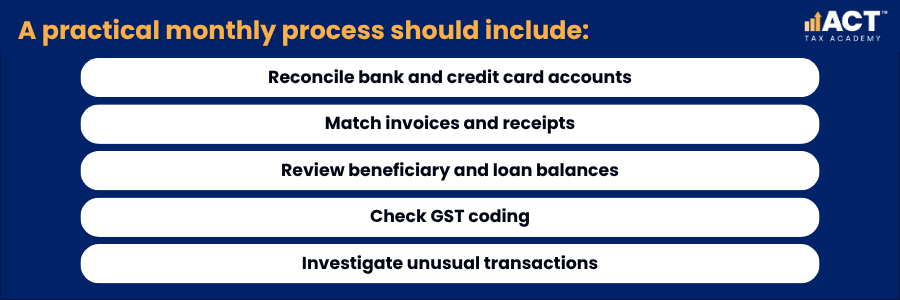
Leaving trust bookkeeping until tax time increases the chance of missing documents, unexplained withdrawals and incorrect beneficiary balances. It also reduces the trustee’s control over tax planning and distribution decisions. A regular process helps the trust meet its obligations and gives the business owner more useful financial information. Monthly reviews also reduce the time and stress involved in preparing the BAS and annual tax returns, which is especially important if the ATO requires monthly BAS reporting for non-compliant small businesses.
Build Practical Bookkeeping Skills
Avoiding common trust bookkeeping mistakes requires more than balancing the bank account. By separating trust and private money, following the trust deed, reconciling beneficiary balances and reviewing records throughout the year, you create more reliable accounts and reduce financial stress. If you are ready to move from theory to practical application, the ACT Tax Academy Bookkeeping Online Course provides structured online training designed specifically for Australian small business owners and aspiring bookkeepers. You will learn how to set up and manage GST, prepare BAS, use Xero effectively, and implement compliant bookkeeping systems with confidence.