Changing Jobs Mid‑Year: How to Update Tax‑Free Threshold Declarations So Your PAYG Stays Accurate
Changing Jobs Mid-Year: How to Update Tax-Free Threshold Declarations So Your PAYG Stays Accurate means checking whether you should claim the tax-free threshold from your new employer. If your declaration form is incorrect, your Pay as You Go (PAYG) withholding may be too low or too high, which can affect your take home pay, cash flow and tax time outcome. In Australia’s tax system, the tax-free threshold, often searched as the tax-free threshold, means most Australian resident taxpayers can claim the first $18,200 of income they earn in the income year before they start paying income tax. Your Tax File Number (TFN) declaration gives your new employer the details they need to calculate the tax withheld from your wages.
What Does Tax Free Threshold Mean When You Change Jobs?
The tax-free threshold is the part of your income that is not taxed, and most Australian residents for tax purposes can claim it on the first $18,200 they earn in the income year. In simple terms, the tax-free threshold works by reducing the amount of tax withheld from your regular pay when you claim it from one employer. Your employer does not calculate your final annual income tax each pay cycle. Instead, the employer withholds tax using your TFN declaration, your pay cycle and the Australian Taxation Office PAYG withholding tax tables.
How The Threshold Affects Your Pay
The tax-free threshold affect is usually seen in your regular pay. If you claim tax free threshold from your employer, less tax is withheld, which may leave more money in your bank account during the year. If you do not claim the threshold, your employer withholds more tax from your wages. This can mean less money now, but it may reduce the risk of owing money or receiving a surprise tax bill later.
Why PAYG Is Not Your Final Tax Result
PAYG withholding is essentially prepaying income tax across the year. It helps spread your tax payments instead of leaving the full amount until your tax return is prepared. Your final tax situation is worked out after the income year ends. The Australian Taxation Office reviews your entire income, deductions, tax offset entitlements, investment income and other income before calculating your tax payable, tax refund or tax bill.
Claiming The Tax-Free Threshold with a New Employer
When you move from one employer to another, you can usually claim the tax-free threshold with your new employer. This is because when your previous employer stops paying you, you no longer claim the tax-free threshold from them. Many employees worry that claiming the threshold earlier in the year means they cannot claim it again. If your old job has ended and your new role is your only job, tax free threshold claiming with the new employer is usually appropriate.
When You Should Not Claim the Threshold Twice
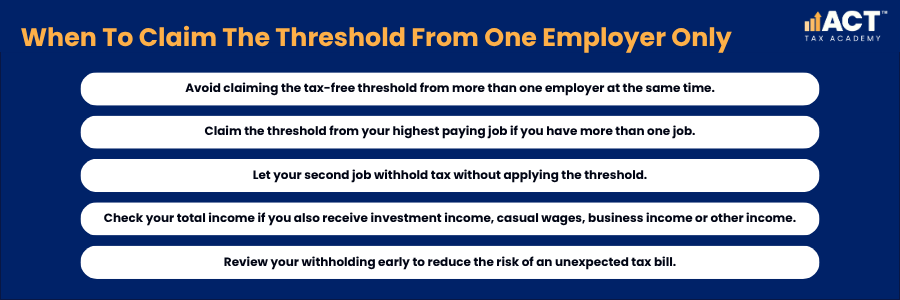
You should generally avoid claiming the tax-free threshold from more than one employer at the same time. If you have multiple jobs, two or more jobs, or more than one income stream, claiming the threshold from each payer may mean not enough tax is withheld. Each employer only sees the income they pay you. If more than one employer applies the threshold, your combined income may produce a larger tax bill or unexpected tax bill when your tax return is assessed.
Choosing The Highest Paying Job
If you have more than one job, you would usually claim the tax-free threshold from your highest paying job. This helps match the tax-free benefit to your main income stream. Your second job can still withhold tax without applying the threshold. Although this may reduce take home pay from that job, it can help prevent underpaying tax across your annual income.
Avoiding A Surprise Tax Bill
A surprise tax bill can happen when two employers both apply the tax-free threshold and your total income is higher than expected. This risk increases if you also receive investment income, casual wages, business income or other income. A small shortfall may be manageable, but ongoing under-withholding can create a tax debt. In some cases, it may lead to a substantial tax debt if not enough tax is withheld during the year.
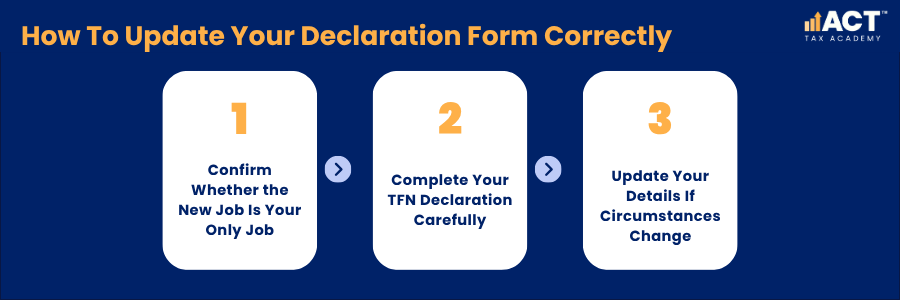
How To Update Your Declaration Form Correctly
You update your tax-free threshold position by completing the correct declaration form. A new employee usually completes a TFN declaration, while an existing employee may use a withholding declaration to change earlier details. This step matters because payroll systems follow the information provided. Your employer cannot accurately manage tax withheld if your tax file number, threshold choice or study loan details are missing or incorrect.
Step 1: Confirm Whether the New Job Is Your Only Job
Before you claim the tax-free threshold, check whether the new job is your only job. If your old job has ended and you do not have a second job, claiming the threshold from the new employer will usually make sense.
If you work for more than one employer, choose carefully. In most cases, claim the tax-free threshold from one employer only, commonly the highest paying job. If you are certain your total income from all payers will be $18,200 or less for the income year, the Australian Taxation Office says you can choose to claim the tax-free threshold from each payer, but you must update one employer with a withholding declaration if your total income later increases above $18,200.
Step 2: Complete Your TFN Declaration Carefully
Your TFN declaration records your tax file number, residency status for tax purposes, tax free threshold choice and relevant study loan obligations. These details affect how much tax is withheld from each pay cycle. Take time to check each answer before submitting the form. A small mistake can cause overpaying tax, underpaying tax, less money in your pay, or a tax debt later.
Step 3: Update Your Details If Circumstances Change
If your circumstances change after you start work, use a withholding declaration to update your details. You may need this if you start a second job, stop a second job, become or stop being an Australian resident for tax purposes, claim or stop claiming the tax-free threshold, update study and training support loan obligations, or claim or vary a tax offset. Updating the form early helps protect your cash flow. It also reduces the risk of a large tax bill after your tax return is processed.
How Employers and Payroll Teams Can Help
Employers can support accurate PAYG by collecting completed TFN declarations before the first pay run where possible. They should also update payroll settings when employees provide a valid withholding declaration. Correct declarations help employees manage income tax, reduce payroll errors and avoid unnecessary stress. This is especially important for employees with multiple jobs, more than one employer or changing income patterns.
Reviewing Your Payslip After Starting a New Job
Your first payslip after starting a new job is a useful checkpoint. It shows your gross wages, tax withheld, superannuation and other details for that pay cycle. You do not need to calculate your full tax system outcome manually. Simply check whether the tax withheld looks reasonable based on your pay amount, whether you claimed the threshold, and whether this is your only job.
When To Ask for Help
Ask payroll for help if your payslip does not match the declaration you submitted. For example, ask for a review if your threshold choice appears wrong, your pay cycle is incorrect, or your study loan obligation is missing. For personal tax advice, speak with a registered tax adviser. This is important if you have a second job, investment income, low-income tax offset eligibility to check, other income, a tax debt, or worries about a large tax bill.

Build Practical Bookkeeping Skills
Changing jobs mid-year does not need to create PAYG confusion if your declarations are accurate and up to date. The key is to know whether you have one employer or more than one employer, claim the tax-free threshold only where appropriate, and check your first payslip so errors can be corrected early.
If you are ready to move from theory to practical application, the ACT Tax Academy Bookkeeping Online Course provides structured online training designed specifically for Australian small business owners and aspiring bookkeepers. You will learn how to set up and manage GST, prepare BAS, use Xero effectively, and implement compliant bookkeeping systems with confidence.